Why So Many Women Don't Discover Their ADHD Until Adulthood
"I thought ADHD meant little boys who couldn't sit still."
It's something I've heard many times over the years.
To be honest, it's probably something I would have said myself once.
As a psychologist, I knew about ADHD, but it wasn't an area I'd specialised in. Like many psychologists, my training covered it at a broad level, but our profession is vast and we naturally develop expertise in different areas throughout our careers.
It wasn't until my own son was assessed for ADHD that I really began to immerse myself in the research.
And something unexpected happened.
The more I learned, the more I started recognising the same patterns in many of the high-achieving adults I worked with. Eventually, I began recognising some of those patterns in myself too.
It left me asking a question that I now hear almost every week:
Why are so many women only discovering they have ADHD in adulthood?
We were looking through the wrong lens
For many years, ADHD was largely understood through research carried out on boys.
The image of ADHD that developed was one of a child who couldn't sit still, interrupted constantly, climbed on furniture and struggled to stay in their seat at school.
Of course, some girls present in exactly that way too.
But many don't.
As our understanding has grown, we've begun to recognise that ADHD can look very different across individuals, and that many women present with patterns that are quieter, more internalised and therefore much easier to miss.
Rather than disrupting the classroom, they may be battling distraction, racing thoughts, emotional overwhelm and constant mental effort that nobody else can see.
The ADHD was there.
We just weren't always looking for that version of it.
Success can hide struggle
One of the biggest myths about ADHD is that people with it can't achieve highly.
In reality, many of the women I meet are exceptionally capable.
They've built successful careers.
They're raising families.
They're dependable, conscientious and often the person everyone else relies upon.
From the outside, they appear to have everything together.
But underneath?
They're exhausted.
I've always loved the image of a swan gliding gracefully across a lake. Above the water, everything looks calm and effortless. Beneath the surface, however, its feet are paddling furiously just to keep moving.
That image reminds me of so many women I work with.
Others see competence.
They experience constant effort.
"You're so organised."
People have often assumed that I'm naturally organised.
The truth is a little different.
Yes, I like structure.
But I don't think I developed those systems because organisation came easily to me.
I developed them because I needed them.
Calendars.
Lists.
Reminders.
Colour-coding.
Planning routines.
Breaking tasks into tiny steps.
Creating what many people now call a "second brain."
Over time, these systems become so effective that they can completely mask what's happening underneath.
From the outside, it looks like organisation is a personality trait.
Sometimes it's actually a compensation strategy.
Many high-achieving women spend years unknowingly building scaffolding around an ADHD brain.
Until one day, that scaffolding becomes harder to maintain.
The hidden emotional cost
Perhaps the greatest cost of undiagnosed ADHD isn't the forgotten appointments or unfinished tasks.
It's the story people tell themselves.
"If everyone else can do this, why can't I?"
"I just need to try harder."
"I'm lazy."
"I'm disorganised."
"I'm failing."
Over years, those thoughts become deeply ingrained.
As psychologists, we sometimes talk about internalised ableism—absorbing society's expectations about what we "should" be able to do and turning them against ourselves.
Many women don't simply carry ADHD.
They carry decades of shame.
The diagnosis isn't always the hardest part.
Sometimes it's grieving the years spent believing you were somehow broken.
Why adulthood can be the tipping point
One reason ADHD can remain hidden for years is that many women become remarkably skilled at compensating.
Until life becomes more demanding.
Perhaps a promotion.
Having children.
Becoming responsible for the invisible mental load of running a household.
Or hormonal changes during puberty, pregnancy or perimenopause.
Emerging research suggests that fluctuations in oestrogen can influence dopamine systems involved in attention and executive functioning. For some women, strategies that have worked for years suddenly seem less effective.
It's not that ADHD has suddenly appeared.
It's that the amount of effort required to keep everything together has finally exceeded the available capacity.
A different way of thinking
One book that particularly challenged my thinking was Divergent Mind by Jenara Nerenberg.
Rather than asking, "What's wrong with these women?", it encourages us to ask a different question:
What if we've misunderstood the way many women's brains work?
That shift feels incredibly important.
Understanding ADHD through a neurodiversity lens doesn't mean dismissing the very real challenges people face.
It means recognising that difference isn't the same as defect.
It also helps explain why so many intelligent, compassionate, successful women have spent years wondering why life seems harder for them than it appears to be for everyone else.
You are not alone
If you've found yourself nodding along as you've read this, please know you're far from alone.
Whether or not ADHD ultimately explains your experiences, understanding how your brain works can be profoundly freeing.
For many women, it's the first step towards replacing years of self-criticism with something far kinder:
Self-understanding.
And from there, self-compassion.
Because perhaps the question was never, "What's wrong with me?"
Perhaps it was simply, "What haven't I understood about myself yet?"
Feeling overwhelmed?
If this article resonated with you, my free 5-Step Overwhelm Reset will help you slow racing thoughts, regain clarity and take your first steps towards feeling more in control.
Download your free guide here → http://welcome.drstoneelevate.com/gift

The Great ADHD Myth?: A psychologist’s perspective on what the programme got right - and what it dangerously missed
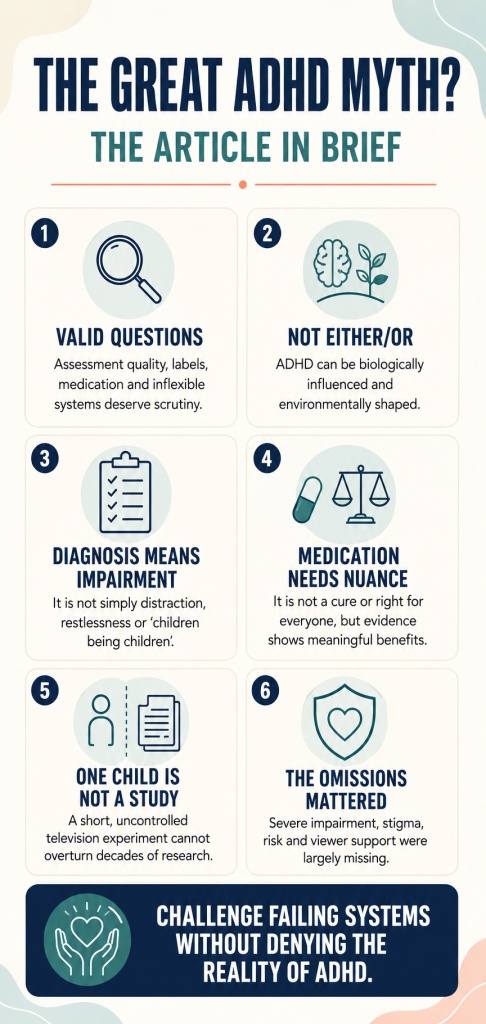
Short on time? Here are the key points
- The programme raised legitimate questions about assessment quality, diagnostic labels, medication, commercial interests, modern lifestyles and inflexible education systems.
- Those questions deserved balanced exploration. Instead, the programme repeatedly presented complex issues as either/or choices and ultimately declared that ADHD is not a neurodevelopmental condition.
- ADHD can be biologically influenced and environmentally shaped. Recognising the role of schools, workplaces, relationships and modern life does not make the underlying difficulties unreal.
- ADHD is not diagnosed simply because someone is distracted, restless or behaves like a child. Diagnosis requires a persistent developmental pattern and significant impairment across important areas of life.
- Medication does not cure ADHD and is not right for everyone. However, research shows that it can reduce core symptoms and may be associated with improvements in serious real-world outcomes. Decisions should be individualised and carefully reviewed.
- One child stopping medication while simultaneously changing his diet, screen use, exercise, outdoor activity and family routines cannot establish what caused any changes or overturn decades of research.
- The programme largely omitted people with severe ADHD-related impairment and provided no support signposting, despite the risk of increasing shame, stigma and distress.
The central message: We should scrutinise assessments, medication, commercial interests and the systems that fail neurodivergent people. We can do that without denying the reality of ADHD or invalidating those whose lives are significantly affected by it.
The Great ADHD Myth?: A psychologist’s perspective on what the programme got right - and what it dangerously missed
By Dr Clare Stone, Chartered Counselling and Coaching Psychologist
As a psychologist, I am trained not to accept claims uncritically simply because they are familiar, popular or expressed by someone in authority. Good psychological science requires curiosity, humility and a willingness to change our minds when the evidence changes.
I therefore did not object to Channel 4’s The Great ADHD Myth? because it asked difficult questions.
There are important questions to ask about the quality of ADHD assessments, the growth of private provision, financial interests in healthcare, the long waits for NHS care, the effects of receiving a diagnostic label, the role of medication and the extent to which schools and workplaces accommodate different minds.
What concerned me was the programme’s polarisation of these questions. Again and again, complex issues were presented as binary choices: biology or environment; neurodevelopmental condition or social construct; medication or lifestyle; helping a child learn or allowing them to be themselves.
The presenter, psychiatrist Dr Max Pemberton, concluded:
“I am now convinced it is a myth that ADHD is a neurodevelopmental disorder. Actually, I think it’s a set of difficult behaviours, a social construct. Not a disorder of the brain.”
This was not expressed tentatively as a personal interpretation or one position within a contested debate. It was delivered with striking certainty, as though the making of one television programme had overturned decades of genetic, developmental, clinical and neuroscientific research.
That use of medical authority is the aspect I found most troubling.
What the programme got right
A balanced response must acknowledge that several questions it raised are legitimate.
Assessment quality needs scrutiny
Not every ADHD assessment is necessarily of equal quality. Long NHS waits have created a market in which private providers vary in their experience, methods, professional composition and follow-up arrangements. Some people pay substantial sums only to discover that their report will not be accepted for prescribing or shared-care purposes. A rushed, questionnaire-led process risks both overdiagnosis and underdiagnosis.
A proper assessment is not simply a matter of recognising a few familiar traits. Many people lose things, procrastinate, become distracted or feel restless. Diagnosis requires a persistent developmental pattern, clinically significant functional impairment and difficulties across relevant settings. It should also consider alternative explanations and co-occurring conditions.
Pemberton paid £1,200 for a private online assessment and received a diagnosis that he rejected because he did not feel disabled or significantly impaired. We cannot judge the full assessment from an edited sequence. If impairment was not established, however, that raises a legitimate question about the quality of that particular assessment.
There is also another possibility worth considering. Intelligent, outwardly successful people can build substantial scaffolding around their difficulties: rigid systems, reminders, overpreparation, reliance on urgency or enormous compensatory effort. This can conceal impairment from others and sometimes from the person themselves.
Those strategies may work for years before increased responsibilities, stress, burnout or hormonal transitions overwhelm them. Many women, for example, describe previously effective coping strategies unravelling around perimenopause, although research into the specific relationship between ADHD and menopause remains emergent.
Diagnosis and labels can affect identity
The programme was also right to invite discussion about what happens psychologically when we give someone, particularly a child, a diagnostic label.
A diagnosis can become a framework for understanding and accessing support. It can relieve years of shame by replacing “lazy,” “badly behaved” or “not trying” with a more accurate account of why some things are difficult. But a label can also be absorbed as a fixed limitation. If communicated poorly, it may contribute to stigma, lowered expectations or learned helplessness.
When my own son was diagnosed, we followed the guidance of his educational psychologist and were careful about how we introduced this. We initially focused less on the diagnostic name and more on helping him understand that his brain worked in a particular way: some things were harder, some strategies could help, and none of this defined his worth or potential.
That is a valid concern for every diagnostic process. But it does not follow that diagnosis inevitably makes people stop trying or that accommodations “excuse” them from developing skills. Appropriate accommodations provide access. They reduce unnecessary barriers so that a person has a fairer opportunity to learn, participate and build skills. Support and personal agency are not opposites.
Medication decisions deserve honesty and compassion
Medication can have side effects. Appetite reduction, sleep disruption and changes in energy or emotional tone should not be dismissed. The teacher’s reflections in the programme were among its most humane moments: medication appeared to help the child engage with formal learning, but people around him also missed some of his playfulness and spontaneity.
That is a real and painful dilemma. Children are not collections of symptoms to be made more convenient for adults.
If someone feels emotionally flattened, “less fun” or unlike themselves, that matters. It may indicate that the dose, timing, formulation or medication should be reviewed. It may contribute to a decision not to medicate. Equally, some children report feeling calmer, more emotionally regulated and more able to sustain friendships while appropriately medicated.
The task is not to impose one answer on every family. It is to weigh benefits and costs for the individual, include the child’s experience, titrate carefully and review the decision over time.
Environment and modern life matter
Sleep, physical activity, nutrition, stress, routines, family support, time outdoors and patterns of screen use can all affect attention, mood and self-regulation. Modern life frequently fragments attention, while many children have less freedom to move, play outdoors and learn through varied activities.
There is evidence that exercise can improve inattention, inhibitory control and cognitive flexibility in children and young people with ADHD. Nature exposure can support attention and mood, although the evidence is more limited and does not establish it as a stand-alone treatment. These approaches are valuable because they can improve wellbeing and functioning, not because they disprove ADHD.
As both a psychologist and a parent, I am aware of the importance of limiting excessive gaming and screens, encouraging outdoor activity, supporting sleep, offering a healthy diet and trying approaches such as yoga. We have done these things with my son. They help, but they have not made his ADHD disappear.
I want to be clear. Families should not be left believing that continuing difficulties mean they have failed to provide the correct food, boundaries, exercise or parenting.
The system does need to change
On this, I agree wholeheartedly with the programme. Schools, workplaces and healthcare systems often fail to accommodate human variation. Support should not depend entirely on a diagnostic label, and medication should never substitute for adequate educational support, reasonable adjustments or psychologically informed care.
Many schools are structured around prolonged sitting, sustained attention, conformity and a narrow range of ways to learn or demonstrate ability. That will disadvantage many learners, with or without ADHD. We should create education systems with more movement, creativity, written and verbal instruction, manageable task lengths and different routes to participation.
But changing the education system and recognising a child’s neurodevelopmental needs are not mutually exclusive. The school environment can be problematic without the child’s difficulties being imaginary.
Where the programme became misleading
“Social construct” was used as though it meant “not real”
There is a limited sense in which ADHD, like diagnostic categories across medicine and mental healthcare, is socially constructed. Humans create the name, define the criteria and decide where a continuous distribution of traits becomes sufficiently impairing to justify diagnosis and intervention.
There is no line drawn by nature labelled “ADHD starts here.” The threshold is a clinical and social decision informed by research, values and the consequences of acting or not acting. Similar judgement is involved when medicine sets thresholds for hypertension, or when psychiatry determines when low mood becomes a depressive disorder.
But the fact that a category and its boundary are constructed does not mean that the underlying traits, distress, impairment, developmental patterns, genetic influences or group-level biological findings were invented by a committee.
The programme repeatedly collapsed those two propositions. It treated “neurodevelopmental” and “social” as mutually exclusive, when contemporary psychology understands people through interactions between biology, development, relationships, culture and environment.
Something can be biologically influenced and environmentally shaped. Its visibility and disabling impact can change with context without the underlying vulnerability being imaginary.
The World Health Organization classifies ADHD as a neurodevelopmental disorder in ICD-11. NICE, the NHS and the DSM-5-TR recognise it. The 2021 World Federation of ADHD International Consensus Statement drew together 208 empirically supported conclusions from large studies and meta-analyses, endorsed by 80 authors across 27 countries. Scientific consensus is not sacred, but overturning it requires evidence of comparable strength, not selective interviews, assertion and a single televised case.
A rise in referrals is not proof of a new epidemic
The programme emphasised how rare ADHD diagnoses once appeared and how sharply referrals and diagnoses have risen. Social media, greater public discussion and changing expectations have undoubtedly influenced help-seeking. Poor-quality information can encourage people to overidentify with ordinary traits, and systems that make support dependent on diagnosis can create additional incentives to seek one.
However, rising recognition and service demand are not the same as rising underlying prevalence.
The Government’s 2026 independent interim review reported that the number of children and young people waiting for an ADHD assessment in England rose from around 21,000 in April 2019 to around 270,000 by December 2025. Yet the best available population surveys suggest that the underlying prevalence of ADHD symptoms has been much more stable, with no evidence of a dramatic population-level increase over recent decades.
The review’s conclusion is more complex: relatively stable underlying prevalence can coexist with rapidly rising referrals, diagnoses and demand. Increased awareness, reduced stigma and improved recognition of groups historically missed; including girls, women and some minority group, can bring previously hidden need into view.
Some overdiagnosis, some misdiagnosis and substantial underdiagnosis can all exist simultaneously. This is precisely the kind of both/and thinking the documentary lacked.
Diagnostic manuals are imperfect tools, not inventions without evidence
Diagnostic systems deserve critical scrutiny. Categories change, thresholds involve judgement, and historical versions have contained serious cultural biases. They should never be treated as infallible maps of human experience.
However, portraying the DSM or ICD as though a few psychiatrists casually invented diagnoses around a table is misleading. These classification systems are not simply invented by a small group of psychiatrists. Their development and major revisions involve reviews of scientific evidence, multidisciplinary expert groups, professional and public consultation, and field testing. Proposed diagnostic criteria are scrutinised in relation to their validity, reliability, feasibility and clinical usefulness.
They are human-made and imperfect, but they are not simply “made up.”
“Diagnosing children for being children” misunderstands impairment
ADHD traits are continuously distributed. Everyone experiences distraction, impulsive moments or restlessness. That is not evidence against ADHD, any more than everyone experiencing sadness makes severe depression unreal.
Diagnosis is not based on the mere presence of recognisable behaviours. It asks whether they are developmentally atypical in their persistence or intensity, evident across settings, traceable to childhood and associated with significant functional impairment. The NHS explicitly notes that many children are distracted, impulsive and energetic and that this alone does not mean they have ADHD.
Presenting ADHD as “children being children” also risks reviving the idea that difficulties arise from permissive parenting or poor discipline. That is both inaccurate and stigmatising.
The presenter’s diagnosis raised questions but did not answer the programme’s thesis
Pemberton’s own ADHD assessment is interesting precisely because several explanations remain possible. The assessment may have been insufficiently rigorous. Functional impairment may have been underexplored or poorly communicated. Alternatively, he may have developed effective scaffolding that obscures difficulties. We cannot determine which from the broadcast.
Nor is it enough to assume that a highly intelligent and professionally successful person could only have mild ADHD. Success does not measure the effort, exhaustion or hidden cost required to maintain it.
The programme appeared to use his diagnosis to suggest that anyone who wants one can obtain one. That sweeping implication was unfair to people who approach assessment reluctantly after years of difficulty, often carrying considerable stigma and self-doubt.
His experience supports an argument for high-quality assessment and regulation. It does not demonstrate that the diagnosis itself is a myth.
The brain-imaging argument confused two different questions
It is true that ADHD cannot currently be diagnosed from an individual MRI scan. Professor Katya Rubia said this in the programme.
What does not follow is that ADHD therefore has no biological or neurodevelopmental basis.
Research can identify average differences between groups without those findings being consistent or precise enough to classify an individual. ADHD is heterogeneous: people meet criteria through different combinations of traits and have different developmental histories, compensatory strategies and co-occurring conditions.
The international ENIGMA mega-analysis of more than 3,200 participants found small group-level differences in several subcortical brain volumes, particularly in children. Large genetic studies have identified multiple regions of DNA associated with ADHD, including links to genes that are particularly active during early brain development. These findings do not provide a diagnostic scan or prove there is one uniform “ADHD brain.” They do contradict the claim that the absence of an individual biomarker proves an absence of biology.
Interestingly, after the broadcast, Professor Katya Rubia subsequently stated that her contribution had been “largely misrepresented”, with comments cherry-picked, truncated and presented out of context.
She clarified that although current brain scans cannot diagnose ADHD in an individual, this does not mean that ADHD has no neurobiological correlates. Three decades of neuroimaging research have identified average group-level differences in brain structure, function and connectivity. She also acknowledged that these differences are generally small and that ADHD is highly heterogeneous, meaning that not every person shows the same neurobiological pattern.
Both facts can be true: current scans cannot diagnose an individual, and credible group-level neurobiological evidence exists.
Neuroplasticity does not mean ADHD can simply be trained away
The brain is plastic. Learning, relationships, stress, practice, medication and environment can change neural pathways and behaviour. This is one reason psychological strategies, coaching, habit-building and adjustments can improve functioning.
But “the brain can change” does not mean that every inherited or developmental vulnerability can be erased through enough effort. Neuroplasticity is a capacity, not a promised cure.
Longitudinal studies following children with ADHD through adolescence and into young adulthood show that symptom severity and presentation can change, and often fluctuate, over time.
This does not mean that ADHD simply disappears: in one major 16-year study, sustained remission was uncommon, and many participants experienced a recurrence after a period of improvement.
Environment and learned strategies can alter how ADHD is expressed and how disabling it becomes. That is not evidence that lifestyle-driven neuroplasticity reliably removes it.
One child’s experience cannot overturn a research field
Mason’s story was emotionally engaging, but it was not a scientific experiment capable of answering whether ADHD exists.
Medication, screens, diet, supplements, exercise, nature exposure, structured activities and family attention all changed together. There was one child, no control group, no blinding and a short follow-up, all within the unusual context of being filmed for television. No causal conclusion can be drawn from that design.
The programme foregrounded the positive changes: Mason seemed happier, more playful and more socially engaged. Yet his teacher later described greater disruption, fidgeting and difficulty completing work. The brief end text revealed that he returned to medication and that his schoolwork improved. Viewers who looked away or switched off early could easily have missed the result that most complicated the programme’s narrative.
This does not prove every child should take medication. It shows that the attempted experiment did not support the sweeping conclusion drawn from it.
I also found myself wondering how Mason’s mother felt watching a programme in which she had participated ultimately declare that her child’s ADHD was a myth. I cannot know her view, but it highlights the ethical tension in using one child’s life as the narrative vehicle for a predetermined conclusion.
Medication does not need to “cure” ADHD to provide treatment
Pemberton argued that medication does not cure anything; it suppresses or controls symptoms. But many accepted medical treatments manage a condition rather than eliminate its cause. Asthma inhalers, antihypertensive medication and many treatments for chronic pain or mental-health conditions work while they are taken. That does not make them fraudulent or dystopian.
The relevant question is not whether medication permanently cures ADHD. It is whether it safely improves symptoms, functioning, autonomy, wellbeing and longer-term outcomes enough to justify its risks for that individual.
Randomised trials show that ADHD medication reduces core symptoms. Large observational studies associate treatment with lower rates of suicidal behaviour, substance misuse, transport accidents and criminality. A 2024 study found that medication initiation was associated with lower all-cause and unnatural-cause mortality during the following two years. Observational evidence cannot prove every benefit is caused by medication, but it directly challenges the claim that medication merely optimises compliant behaviour.
Medication is not right for everyone. NICE recommends implementing and reviewing environmental modifications first, then offering medication to children aged five and over, young people and adults when significant impairment persists. Treatment should be individualised rather than governed by ideology in either direction.
What the programme missed
The people most severely affected
Where were the adults unable to sustain employment despite enormous effort? Those overwhelmed by daily administration, unsafe impulsivity, debt or relationship breakdown? The people living with secondary anxiety, depression, addiction or profound shame? Those whose outward success depends on exhausting compensation and eventually ends in burnout?
Unsupported ADHD is associated with higher risks of educational failure, accidents, substance misuse, criminal-justice involvement, mental-health difficulties and premature mortality. This does not mean every person with ADHD experiences disability in the same way, but it makes dismissive framing consequential.
A programme asking whether ADHD is real should include the experiences most capable of challenging its preferred conclusion, including adults and people at the severe end of the spectrum.
The possibility of difference, disability and contextual strength coexisting
Some people understand their ADHD primarily through neurodiversity rather than disorder. Some experience contextual strengths and do not identify as disabled. This is where some ADHD-related traits can be helpful in the right circumstances. For example, intense focus, creativity, spontaneity or rapid thinking may be valuable in certain roles or environments, while those same traits may create difficulties in others. Others experience ADHD as profoundly disabling. Neither should be required to speak for everyone.
The right question is not simply “difference or disorder?” It is: what is this person experiencing, how is it affecting their life, what strengths and needs are present, and what combination of environmental, psychological, educational and medical support would improve their autonomy and wellbeing?
The potential harm - and the absence of support
The Royal College of Psychiatrists warned after the programme that invalidating a neurodevelopmental condition can fuel stigma and discourage people from seeking support and treatment.
For someone already wondering whether they are lazy, weak, badly behaved or making excuses, hearing a psychiatrist declare with certainty that ADHD is a myth can deepen shame. Parents may feel blamed. Employers and teachers may feel licensed to withdraw understanding. People may stop medication or abandon an assessment without seeking appropriate advice.
Having rewatched the programme and watched the end credits carefully, I could find no signposting to support for viewers who felt distressed or triggered. Given the well-established association between ADHD and increased rates of depression, self-harm and suicide, failing to provide even basic support signposting was not a minor oversight. In my view, it was a grave and inexcusable failure of responsibility towards the very people the programme knew, or should have known, could be deeply distressed by its content.
Conclusion: challenge the system, not the existence of the people it is failing
The programme was right that our systems need to change. It was right to question assessment quality, commercial incentives, overreliance on medication and educational environments that demand a narrow range of behaviour. It was right to show that medication decisions can involve real loss as well as benefit. It was right to ask what diagnostic labels do to identity.
But none of those points demonstrates that ADHD is a myth.
We can recognise that diagnostic categories have socially constructed boundaries while accepting that the phenomena they describe are real. We can value neurodiversity while acknowledging disability. We can improve nature access, exercise, diet, sleep, schooling and screen habits without pretending they reliably remove a highly heritable developmental condition.
We can scrutinise private clinics and pharmaceutical companies without treating every clinician as corrupt or every patient as a consumer purchasing an excuse. We can offer accommodations while still building skills and agency. We can use medication carefully without portraying it as either a miracle or punishment.
What I hoped to see was a genuinely critical programme: one that put controversial claims beside the strongest evidence against them, included researchers with substantial ADHD expertise, represented people across levels of impairment and allowed viewers to reach informed conclusions.
Instead, I saw a highly polarised, one-sided argument presented with the authority and appearance of a scientific investigation.
I believe it is legitimate to ask Channel 4 and the relevant professional regulator to consider whether appropriate evidential, editorial and professional standards were met. That is not to presume misconduct. It is to ask who is accountable when authoritative health communication may foreseeably cause harm.
The response since the broadcast has offered some hope. Psychologists, psychiatrists, neuroscientists, researchers, charities, advocates and people with lived experience have challenged omissions and stood beside those who felt invalidated. Professor Rubia has clarified that her contribution was taken out of context. ADHD UK has complained to Ofcom. The Science Media Centre has collated detailed responses from specialists in ADHD research and clinical practice.
That collective response matters. It tells people with ADHD, those awaiting assessment and those still trying to understand themselves:
You are seen. Your experiences are real. You are not standing alone.
Sources and further reading
- Science Media Centre: expert reaction to The Great ADHD Myth?
- ADHD UK: Challenging Channel 4’s The Great ADHD Myth?
- Channel 4 press release for The Great ADHD Myth?
- UK Government (2026): Independent review into mental health conditions, ADHD and autism — interim report
- NICE guideline NG87: ADHD diagnosis and management
- NHS: ADHD in children and young people
- Faraone et al. (2021): World Federation of ADHD International Consensus Statement
- Hoogman et al. (2017): ENIGMA mega-analysis of brain volumes
- Demontis et al. (2023): Genome-wide analyses identifying 27 ADHD risk loci
- Sibley et al. (2022): Variable patterns of remission from ADHD
- Vysniauske et al. (2023): Exercise interventions for children and adolescents with ADHD
- Dalsgaard et al. (2015): Mortality in people with ADHD
- Li et al. (2024): ADHD pharmacotherapy and mortality
- Zhang et al. (2025): ADHD treatment and real-world risks
This article offers general psychological information and commentary. Anyone considering changing or stopping ADHD medication should first speak with their prescriber.

The Great ADHD Myth? The Real Myth Is That This Is Responsible Journalism
Channel 4’s controversial new ADHD documentary, The Great ADHD Myth?, will air on Tuesday 18 August at 8pm.
I have not seen the documentary yet.
It may contain thoughtful contributions. It may raise legitimate questions about ADHD diagnosis, medication and the effects of modern life on our attention. These are important conversations.
However, my concern is not currently with the contents of the documentary.
It is with the way Channel 4 has chosen to market it.
And I believe Channel 4 should be ashamed.
Is ADHD “genuine”?
Channel 4 announced The Great ADHD Myth? with a press release stating that the programme would seek to determine “whether ADHD is a genuine neurodevelopmental disorder, or a social construct.”
It opened by asking whether children should be given “powerful psychiatric drugs” to medicate it.
These words were not taken out of context by an angry social-media user. They were deliberately chosen by Channel 4 to generate interest in its own programme.
Words matter.
When you place the word “myth” beside an already highly stigmatised condition and ask whether it is “genuine,” you are not simply opening a neutral scientific discussion.
You are planting doubt.
You are handing ready-made language to people who already believe that ADHD is an excuse, a fashionable label, poor parenting or a lack of discipline.
Channel 4 understands how headlines work. It understands that provocative language generates reactions, arguments, shares and viewers.
But people with ADHD should not become collateral damage in a marketing campaign.
Debate is not the problem
There are important questions to explore about ADHD.
Why are more people seeking assessment? Why have so many women and adults previously been overlooked? Are all assessments completed to an appropriate standard? How do sleep, stress, trauma, technology, education and working conditions affect our attention? When is medication appropriate, and how should it be monitored?
Our environment unquestionably influences our ability to concentrate.
Johann Hari’s Stolen Focus, for example, explores research and arguments about the societal forces competing for our attention. Phones, algorithms, chronic stress, disrupted sleep and constant interruption can all make concentration more difficult.
For somebody with ADHD, these conditions may intensify difficulties that are already present.
Recognising environmental influences does not require us to deny biological or developmental differences. Biology and environment are not competing explanations. Human beings are always shaped by interactions between our genetics, development, relationships, experiences and surroundings.
Presenting ADHD as either a “genuine” neurodevelopmental condition or a social construct therefore creates a false and unnecessarily inflammatory choice.
ADHD is not a myth
ADHD is recognised within established international diagnostic systems. In the UK, NICE has an evidence-based guideline covering its recognition, assessment and management in children, young people and adults.
The scientific evidence does not suggest that ADHD was suddenly invented by smartphones or social media.
The World Federation of ADHD International Consensus Statement brought together 208 evidence-based conclusions approved by 80 authors from 27 countries. The research reviewed supports the substantial heritability of ADHD, its presence across different countries and cultures, and the involvement of both genetic and environmental factors.
Research has also identified modest average differences in aspects of brain development, structure and function between groups of people with and without ADHD.
That does not mean ADHD can be diagnosed using a brain scan. It cannot. These are group-level findings rather than a test that can determine whether one individual has ADHD.
They do, however, form part of a much broader body of evidence that cannot reasonably be reduced to people being distracted by their phones or seeking an excuse for their difficulties.
Science should always remain open to scrutiny. Diagnostic practices, prescribing decisions and the quality of services should be examined carefully.
But scrutinising how ADHD is diagnosed and treated is very different from asking whether ADHD itself is genuine.
ADHD UK challenged Channel 4
On 4 August, the charity ADHD UK sent an open letter to Channel 4 raising concerns about the title, promotional framing, scientific balance and potential impact on people with ADHD.
The letter did not ask Channel 4 to avoid difficult questions. It explicitly acknowledged that waiting lists, service failures, diagnosis and treatment deserve serious investigation.
Its objection was to presenting an established neurodevelopmental condition as a possible myth in order to launch that discussion.
Channel 4 replied on 10 August. It said its remit includes stimulating public debate and challenging conventional understandings. It confirmed that the title was posed as a question intentionally because the programme seeks to “encourage debate.”
This response was deeply disappointing.
It treats the objection as though people with ADHD and those advocating for them simply do not want debate. That entirely misses the point.
Debate can be healthy. The problem is the way Channel 4 has chosen to manufacture that debate.
Adding a question mark does not remove the impact of the word “myth.” Nor does saying that the title is not a definitive statement undo the doubt it creates.
To be fair, Channel 4 did respond to some specific points. It identified the professionals involved in overseeing a child’s break from ADHD medication during filming, and it cited newer NHS data to defend one of its prescribing statistics.
Those answers should be acknowledged.
What its response did not meaningfully acknowledge was the central concern: the foreseeable effect of inviting millions of people to question whether ADHD is genuine.
There was no apology for the promotional framing, no indication that the title would be reconsidered and no recognition that harm can occur before the documentary has even aired. ADHD UK also reports that it was offered no preview or right of reply, and received no commitment that support would be signposted during the programme.
That is not an adequate response to the concerns being raised.
ADHD stigma has real consequences
In my work as a psychologist, I regularly encounter the effects of ADHD stigma.
I work with people who have spent years being described as lazy, careless, unreliable, undisciplined or simply not trying hard enough.
Some have experienced discriminatory or deeply insensitive treatment in the workplace. Others face disbelief within their families and relationships.
Comments such as “everyone is a bit ADHD these days” or “it’s just an excuse” remain remarkably common.
These attitudes affect whether people seek an assessment, disclose a diagnosis or ask for reasonable support. They influence whether children grow up understanding their difficulties or believing there is something fundamentally wrong with their character.
Receiving an ADHD diagnosis does not absolve somebody of responsibility for their behaviour. It can, however, give them a framework for understanding themselves, accessing appropriate support and developing strategies that work for their brain.
Questioning whether their condition is genuine reinforces the very shame and misunderstanding many have spent years trying to overcome.
Matt Haig is right to challenge the title
Author Matt Haig, who has spoken openly about his ADHD diagnosis, was among those who challenged Channel 4’s announcement.
He wrote that the title “causes real damage” and referred to evidence from family, twin and neuroimaging research. He also described the clarity that receiving an ADHD diagnosis gave him after being labelled as having special needs at school without being told why.
His response brings the human consequences back into view.
This is not simply an intellectual debate among broadcasters, clinicians and commentators. It concerns real people who often lived with these difficulties for decades before finally having language to understand them.
Ethical communication matters
As a psychologist, I think carefully about how I communicate psychological ideas.
I could probably attract more attention by using frightening headlines, oversimplifying research or deliberately provoking outrage. Emotionally charged and threatening information captures attention quickly.
But attracting attention is not the only consideration.
I have a professional and ethical responsibility to consider the effect of what I put into the world. I want my work to increase understanding, reduce shame and help people make sense of their experiences—not exploit vulnerability or controversy to generate clicks.
A major public-service broadcaster should apply the same principle.
Channel 4 could have promoted a rigorous investigation into rising ADHD referrals, assessment standards, medication and the effects of modern environments.
It could have encouraged curiosity without questioning whether ADHD itself is genuine.
Instead, it chose The Great ADHD Myth?
People with ADHD deserve better
I will reserve judgement on the documentary itself until it has been broadcast. I sincerely hope its contents are more balanced and scientifically responsible than its marketing suggests.
But the effect of its promotional framing is already being felt.
People with ADHD are once again being asked to defend the legitimacy of their condition. Advocates and professionals are having to correct misconceptions before the programme has even aired. Meanwhile, those who already dismiss ADHD have been given a national headline that appears to validate their prejudice.
There is room for debate about diagnosis, treatment, environmental influences and the way society responds to human differences.
There should not be a need to debate whether an established neurodevelopmental condition is “genuine” simply to sell a television programme.
People with ADHD deserve thoughtful journalism. They deserve evidence rather than insinuation, curiosity rather than clickbait, and public conversations that increase understanding instead of deepening stigma.
They deserve better than this.
ADHD Burnout at Work: Why High Achievers Get Stuck in a Cycle of Exhaustion
ADHD burnout is increasingly recognised as a common experience for many adults with ADHD, particularly high-achieving professionals.
Unlike general workplace burnout, ADHD burnout is often linked to years of masking difficulties, compensating for executive functioning challenges, and relying on urgency to maintain performance.
Recently, I was reading an article by consultant psychiatrist Dr Stefan Ivantu about ADHD and career burnout. One idea stood out to me because it mirrors something I’ve seen repeatedly in both my professional work and personal experiences around ADHD.
Many people assume burnout happens because someone takes on too much.
But for many adults with ADHD, the process often starts much earlier.
It starts with compensation.
The Hidden Cost of Coping
Many adults with ADHD become incredibly skilled at finding ways around their difficulties.
They work longer hours.
Double-check everything.
Over-prepare.
Create endless systems.
Use anxiety, pressure or deadlines to get things done.
From the outside, they often appear successful, capable and dependable.
Yet maintaining that level of performance can require an enormous amount of energy.
This is particularly true for professionals, business owners, healthcare workers, teachers, parents and anyone who feels a strong responsibility to perform well.
The problem isn’t a lack of effort.
It’s that effort that becomes the solution to everything.
The ADHD Burnout Cycle
The infographic below illustrates a pattern that many adults with ADHD will recognise.
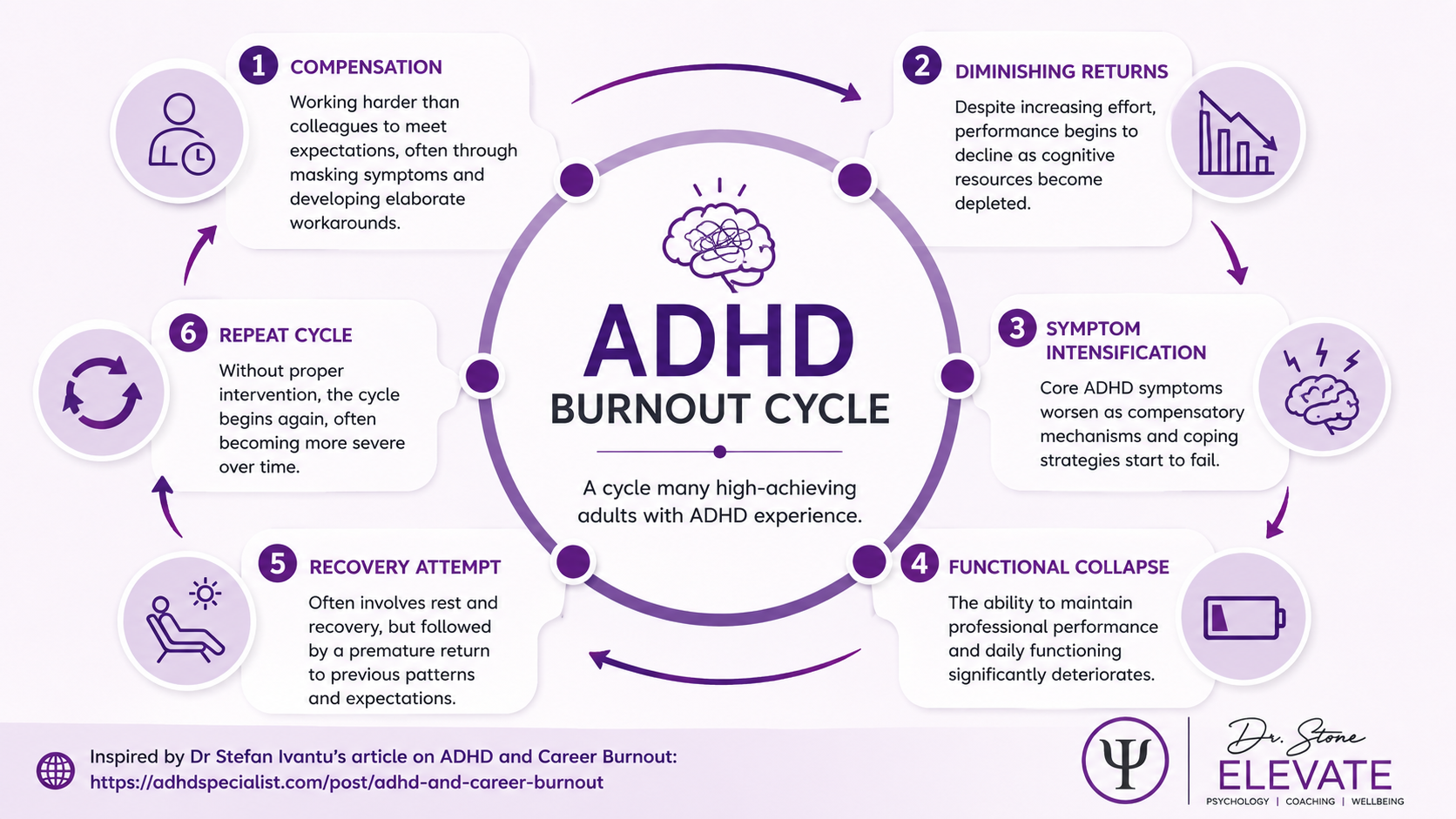
What strikes me about this cycle is that ADHD burnout doesn’t begin with exhaustion.
It begins with working harder.
Many people spend years compensating for difficulties that others never see.
Eventually, however, those strategies become harder to sustain.
Mental resources become depleted.
Concentration becomes more difficult.
Organisation starts to slip.
Emotional regulation takes more effort.
Many people assume they are becoming lazy, less capable or less motivated.
In reality, they may simply be experiencing the effects of ADHD burnout.
Common Signs of ADHD Burnout
Although everyone’s experience is different, common signs of ADHD burnout can include:
- Persistent exhaustion, even after resting
- Increased forgetfulness
- Difficulty concentrating
- Feeling overwhelmed by everyday tasks
- Increased procrastination
- Emotional sensitivity or irritability
- Loss of motivation
- Feeling unable to keep up with responsibilities that previously felt manageable
Many of these symptoms can be mistaken for laziness, lack of discipline or personal failure.
In reality, they may be signs that your brain and nervous system have been working overtime for too long.
Why Rest Alone Doesn’t Solve ADHD Burnout
When people reach breaking point, they often know they need rest.
Perhaps they take annual leave.
Reduce their workload.
Or take some time away from responsibilities.
And often they feel better.
The difficulty is that recovery doesn’t automatically change the pattern.
Many people return to the same expectations, the same overcommitment, the same perfectionism and the same habit of pushing through warning signs.
Before long, they find themselves back in the same cycle.
This is one reason why ADHD burnout can feel so confusing.
You recover, but somehow end up back where you started.
Breaking the Cycle
In my experience, recovering from ADHD burnout isn’t simply about becoming more productive.
It’s about becoming more aware.
Recognising early warning signs.
Understanding how your brain works.
Learning that rest isn’t something that needs to be earned.
And creating ways of working that don’t rely entirely on pressure, urgency and adrenaline.
Because if your success depends on constantly compensating, masking and pushing beyond your limits, burnout isn’t necessarily a sign that you’ve failed.
It may simply be a sign that the strategy itself is no longer sustainable.
A Question to Reflect On
As you look at the cycle above, which stage do you recognise yourself in right now?
The answer might tell you more about your wellbeing than any productivity app ever could.
Feeling overwhelmed?
If this article resonated with you, my free 5-Step Overwhelm Reset will help you slow racing thoughts, regain clarity and take your first steps towards feeling more in control.
Download your free guide here → http://welcome.drstoneelevate.com/gift
This article was inspired by insights from consultant psychiatrist Dr Stefan Ivantu’s work on ADHD and career burnout. You can read the original article here: https://adhdspecialist.com/post/adhd-and-career-burnout
ADHD: Is It Time We Rethink the Name?
What if one of the most common things people believe about ADHD isn't actually true?
The more I've learned about ADHD as a psychologist, as a parent, and through my own personal experiences, the more I've found myself questioning the name itself.
Attention Deficit Hyperactivity Disorder.
It's a label most of us recognise, but I'm not convinced it accurately reflects what many people with ADHD actually experience.
As a psychologist, I spend a lot of time supporting people who are struggling with overwhelm, burnout, confidence, self-criticism and life transitions. Increasingly, many of those conversations involve ADHD.
This is also a topic that feels personal to me.
I identify with many ADHD traits, although I do not currently have a formal diagnosis. My son has ADHD (predominantly inattentive presentation), and my partner has ADHD combined presentation. Alongside my professional training, I've spent years learning about ADHD through lived experience, supporting loved ones, undertaking specialist training, and working with many neurodivergent individuals throughout my career.
Many adults discover ADHD later in life after years of struggling with concentration, overwhelm, procrastination, burnout, emotional regulation difficulties, or simply feeling different from those around them. For some, receiving a diagnosis brings a profound sense of relief and understanding. For others, it raises new questions about identity, strengths and challenges.
One of the questions I keep coming back to is whether the name itself tells the full story.
Is ADHD Really an Attention Deficit?
When most people hear the term "attention deficit", they assume it means a lack of attention.
But that isn't what many people with ADHD describe.
In fact, many people with ADHD can focus exceptionally well.
Sometimes incredibly well.
They can become completely absorbed in topics that interest them. Hours can disappear. Creativity can flow. Complex problems can be solved. They may notice details that others miss and demonstrate extraordinary persistence when engaged in something meaningful.
The challenge isn't necessarily having too little attention.
The challenge is often having difficulty regulating attention.
Some tasks seem almost impossible to engage with, regardless of how important they are. Other activities capture attention so completely that switching away becomes difficult.
It's less about a deficit and more about inconsistency.
Many people with ADHD find that their attention is drawn more strongly by interest, novelty, urgency or emotional significance than by importance alone.
That's a very different thing.
The ADHD Adults Nobody Notices
When many people think about ADHD, they still picture the stereotypical child who can't sit still in class.
But that's often not the reality.
Many adults with ADHD don't fit the stereotype people expect.
They may be professionals, healthcare workers, teachers, business owners, managers, parents or students.
They can be highly intelligent, capable and successful.
They often appear organised and competent from the outside.
Yet behind the scenes, they may be working twice as hard as everyone else just to stay on top of things.
They may spend enormous amounts of energy masking difficulties, compensating for forgetfulness, over-preparing, managing overwhelm, or trying to avoid letting people down.
By the time they seek support, many are exhausted.
Not because they're incapable.
But because they've spent years trying to meet expectations in ways that don't come naturally to them.
The Part I Struggled With Most
When my son was diagnosed, I remember feeling enormous relief.
For years, I had been noticing things that others weren't seeing.
His difficulties weren't always obvious at school. He was bright, generally well behaved, and achieving within expected ranges. Much of the struggle happened at home.
The diagnosis brought validation.
But it also brought something I found surprisingly difficult.
The word "disorder".
As a parent, it's hard to hear your child described in deficit-based terms.
No parent wants their child to believe they are 'broken'.
No parent wants them to believe there is something fundamentally wrong with who they are.
Of course, diagnoses have an important purpose. They help people access support, accommodations, understanding and, where appropriate, treatment.
For many people, receiving an ADHD diagnosis is life-changing and deeply validating.
But I still wonder whether the language we use fully captures the whole picture.
What If ADHD Is Also a Difference?
ADHD can absolutely be disabling.
Many people experience significant challenges with organisation, planning, emotional regulation, impulsivity, memory, relationships, education, employment and mental health.
Those difficulties are real.
They deserve to be recognised.
But from a neurodiversity perspective, many people would argue that ADHD is not simply a collection of deficits.
It is a different way of processing information, responding to the environment and experiencing the world.
Alongside the challenges, many people with ADHD demonstrate remarkable creativity, innovation, curiosity, intuition, energy, problem-solving ability and out-of-the-box thinking.
The question becomes:
How much of the struggle comes from the individual?
And how much comes from living in environments that were designed with a different type of brain in mind?
Perhaps the Problem Isn't Always the Person
Modern life places enormous demands on executive functioning.
Sustained attention.
Administrative tasks.
Organisation.
Planning.
Time management.
Prioritisation.
Working quietly for long periods.
Managing endless notifications and competing demands.
These are exactly the areas many people with ADHD find most challenging.
Yet these expectations are often treated as the default standard for everyone.
When someone struggles, the assumption is often that they need to try harder.
Be more disciplined.
Get organised.
Use a better planner.
Apply more effort.
But what if the issue isn't effort?
What if the issue is fit?
What if some of the distress comes from spending years trying to force yourself to function in ways that don't align with how your brain naturally works?
A More Helpful Conversation
I'm not suggesting we abandon diagnosis.
Nor am I suggesting we ignore the very real difficulties ADHD can create.
What I am suggesting is that perhaps we need a broader conversation.
One that recognises both the challenges and the strengths.
One that acknowledges disability without reducing people to deficits.
One that moves beyond asking, "What's wrong with you?" and instead asks:
"What do you need in order to thrive?"
For many people, that shift in perspective can be transformative.
Because understanding your brain isn't about discovering what's broken.
It's about discovering how you're wired—and learning how to work with it rather than against it.
If you've recognised yourself in parts of this article, you're not alone.
Whether you're newly diagnosed, questioning whether ADHD may be relevant to you, or simply trying to understand yourself better, self-understanding is often the first step towards meaningful change.
I regularly write about ADHD, burnout, perfectionism, confidence and psychological wellbeing. If these topics resonate with you, you can follow my work on LinkedIn or subscribe to my newsletter for future articles, insights and resources.
Feeling overwhelmed?
If this article resonated with you, my free 5-Step Overwhelm Reset will help you slow racing thoughts, regain clarity and take your first steps towards feeling more in control.
Download your free guide here → http://welcome.drstoneelevate.com/gift
Let's Talk About Sleep
Sleep doesn't matter. Would any of you agree with that?
Yet the interesting thing is, for most of us, our behaviour suggests just that. We don't prioritise it.
Who Should Read This
This article isn't just for those who would identify as having insomnia. Even if you think your sleep is ‘about average’ and you are coping ‘just fine’, I would encourage you to read ahead. You may just be surprised.
Taking on board some of the advice and tips here could actually result in an improvement in your physical health and your emotional and mental wellbeing. It may improve your productivity, your concentration and your memory. It could reduce stress and anxiety, improve mood and restore energy levels. Have I got your attention now?
Here’s a shock
What if I were to tell you that even if you think you're getting sufficient sleep just now, you probably aren't? That's because the average amount of sleep that our population is getting has been gradually reducing year on year. But although this continues to decline, the need that we have as humans for sleep has not changed. We've not evolved past the amount of sleep we need,
By comparison, you may think that you get about the same amount of sleep as most people you know, but (NEWSFLASH) that does not mean that you get sufficient or optimal sleep. You may think that you function ‘just fine’ on five, six, or even seven hours of sleep. I'm here to tell you that simply isn't true.
Even a small shortage in your average required sleep can actually have quite a large detrimental effect on you. There are studies which have shown that this may have wide-ranging effects such as impact on cardiovascular, endocrine, immune and nervous systems!
Are you sure you are not drunk?
Not only that, I remember being very struck when I read one particular book on the topic of sleep, and they cited a study that looked at the reaction times of people who had only a very short amount of deficit of optimal sleep. So in other words, people who were probably considered to be ‘typical’ who would not identify as having a sleep problem.
The results were shocking. The reaction times were impacted significantly by just that average of one hour less sleep than what was needed. To the extent that their reaction times were very similar to those that had been under the influence of alcohol!!
You may well be able to argue that you function ‘just fine’ with a bit less sleep than what is recommended. But, although you function just fine, that does not mean that's what's best for you or what is optimal. In fact, based on the results of this study, it may be having more of an effect than you think.
Would you like to be healthier, happier and perform more optimally?
I'm sure many of us would say yes to at least some if not all of those. If you said yes to any of these, then there is one very, very simple thing to try first. Prioritise trying to get enough sleep.
For every single client that I work with, whether it be therapy or coaching clients, I always ask about their sleep. No matter what we are working on. This is because it is a fundamental and foundational aspect of your life. Small tweaks to something as simple as your sleep habits can actually equate to quite a big difference in your life. Many of my clients have fed back that even when they've been sceptical at first, the simple act of working on improving sleep results in very positive changes in a short space of time.
So how much sleep do I need?
Now, the average person requires, as we know, about eight hours of sleep in order to be healthy, happy and to really support our bodily and mental functions. Now, although that's the average and this is generally what most people need, there are some variations in that as well to consider.
It could depend on the age. Teenagers tend to require a bit more sleep than elderly people, for example. Elderly people don't usually need quite as much sleep. It can also depend on gender. I've seen some interesting studies recently that show that women actually tend to require a bit more sleep than men.
It depends…
It can also depend, on other personal factors. Some days you seem to just need more sleep than others. This could be because of health issues, changing hormones, stress, amount of exposure to daylight, exercise levels and so it goes on and on. The key to knowing how much sleep you need is to essentially evaluate how you feel the next day.
Clear confirmation you need more sleep if you are feeling particularly lethargic and tired, lacking energy, and relying on stimulants to get through your day such as coffee, tea, or sugary or fatty things. This is especially thought to be the case if you feel this way in the morning. Feeling sleepy in the morning is a clear sign that your body probably isn't getting enough sleep and you could do with paying attention to that.
Step 1 – track it
Now, one of the very first things I suggest that people do is to start tracking their sleep. So in other words, you can't improve it until you know currently what your sleep is like.
Even if you think it is not necessary to track your sleep, I still highly recommend doing so. I guarantee you will most likely be surprised. How much sleep you think you are getting is most likely not the case.
How to track
There are many different and simple ways to track your sleep. Find a way that works for you. Even if you just do this for one week, it can be an eye-opener and give you a starting point for making improvements. The purpose of this is just to get a true sense of how much sleep you tend to actually get on an average week.
There are lots of apps out there that can help you. I know many of us also have smart watches which allow us to track our sleep too. There are debates about the accuracy of these, as it very much depends on the technology being used to monitor your sleep. However, using something is better than nothing.
You can keep it simple
Rather than using technology, there is a very simple, back-to-basics, way. Keep a notepad and pen next to your bed. Take note of when you go to bed, when you think you got to sleep, roughly what time you've woken up, and when you rose out of bed.
It is important to not only note the duration of sleep but also rate the quality of sleep. Take note of how you are feeling the next day. How was your energy that day? How was your mood? That should give you a little bit of insight into the amount of sleep you are getting and how it is affecting you.
Tracking your sleep can be a really helpful starting point to figure out if you are indeed getting enough sleep or not. It is hard to argue with the numbers. If you are getting enough sleep, congratulations, you are in the minority of the population!
You can also oversleep
Some have the opposite problem of oversleeping. Getting too much sleep is just as problematic as not getting enough. Once you have tracked your sleep for a week, you can identify if you are under-sleeping, oversleeping, or just right. Then you can start to make a plan to improve things.
Start improving things
Let’s use an example: L gets, on average, about two hours less sleep than they ideally should. If their usual time to go to bed is midnight, they may try and aim for heading to bed by 10 pm as their end goal. It is not a good idea to jump straight to going to bed 2 hours earlier, as chances are they will not be able to sleep. So L may start bringing their bedtime back by 10 minutes every 2-3 nights until they finally reach the desired end point. This allows their body to gradually adjust to the change.
In planning any changes to sleep you will of course need to factor in any lifestyle factors specific to you, so you can be realistic following your new plan. The best thing to do is to make small changes at a time.
Wind things down
Whatever your bedtime routine is going to be, I always recommend having a bit of a wind-down routine. Stick to doing the same things in the same order every night. That helps your brain to essentially get the signal that it’s time to start the shutdown processes. This means that it allows the chemical processes to start happening in your brain, in order to shut down for sleep.
No screens
Having a rule about no screens at least an hour before bedtime is also extremely helpful. That includes phones, I'm afraid.
Phones and screens stimulate the brain too much and can prevent the chemical shutdown process that we need to happen in order for us to fall asleep.
Look out for our next article for more helpful tips
I hope this article has been helpful in highlighting the importance of paying attention to your sleep and prioritising making improvements. Such a seemingly small thing can make a big difference.
Make sure you look out for our upcoming article, which will give more practical tips on how to help improve your sleep.
Dr Clare Stone
Senior Chartered Coaching Psychologist

What is Your Superpower - How to Tap Into Your Fullest Potential
Ever wonder if focussing only on your weaknesses might not be the most effective approach or use of your time. What if I told you that by spending more time harnessing your strengths you could reach new heights in your personal and work life? Read on for more...
Click below for the link to Dr Clare Stone's recent Brainz magazine article.

WARNING! Kindness May Be Good for Your Health!
Health benefits of Kindness
I was reading an article this week by Dr David Hamilton about the possible health benefits of kindness. He was making the link between feelings induced by kindness and the release of a hormone known as Oxytocin. This is our happy drug, which gives us a rush of love, also known as the hug hormone.
A study from the University of Miami found that oxytocin helps to prevent cardiovascular disease. This is because the hormone is thought to help to keep blood vessels clear.
The negative physical impact of chronic and high levels of stress on the human body has been well documented. Many of us have experienced burnout and know both the psychological and physical toll this takes on our bodies. Over-exposure to the stress hormone known as cortisol has been associated with an increase in many health problems including but not exclusive to; anxiety, depression, digestive problems, headaches, heart disease, skin conditions, sleep problems, weight gain, memory & concentration impairment.
But on the flip side - the idea that kindness could actually be good for our health! Well! It’s not just nice to be nice, but it turns out that it can potentially be of benefit whether you are the giver or receiver.
The Kindness of Strangers
After reading this article, later in the day, in some kind of serendipitous moment, I rushed to the local supermarket as I realised I needed one extra ingredient for dinner that night. I got there only to realise that I forgot my face mask. I NEVER forget my mask as I have one in almost every jacket pocket and usually leave one in my car at all times. It was an unusually sunny afternoon so I had no jacket, and the mask from my car had magically disappeared.
I stood outside the shop grumbling to myself that I didn’t have time to go back for my mask when a kind stranger overheard my troubles and offered to go into the shop to find a worker and ask if they had a mask I could use. Like some supermarket hero, she emerged with a mask, which she handed to me. This person could have just stood by and ignored my moaning, or continued on with her day. But no, she saw someone had a problem and felt compelled to use some of her precious time to take action solely for the purpose of helping another.
I know that this could seem like a relatively small thing to do, and from the look on my rescuers face she really thought nothing of it. BUT can I just reinforce that tiny acts of kindness like this mean a whole lot to the person on the receiving end. It meant I didn’t have to rush back home and saved me about 30 minutes of time, it meant my kids would get their dinner on time, it meant that the foul mood I was in lifted because ‘there are some kind souls on this planet who care’. Don’t underestimate the act of showing care for another being on this planet!
Being Kind IS NOT WEAK!
I know that sometimes we can be reluctant to show kindness as there is a misconception that being kind = being weak. I am here to flip that on its ridiculous head and say that it takes real bravery to be kind. It can show an incredible amount of strength and power of character to be kind to another, even when they are not particularly deserving of that kindness.
‘Does that mean they will take advantage of my kindness?’ – well the answer to that is, only if you let them.
Being kind does not mean being a pushover, or saying yes to everything. Have you ever thought that sometimes the kind thing to do is to walk away, or to not give in to the other person’s desires? What defines whether an act is kind or not has nothing to do with how NICE you are being, but more to do with the intentions behind your act. If you are acting in what you perceive as the best interests of the person, well this is the best that any of us can do. We do not always get it right, but all we can do is try.
Being Kind Does Not Mean People Pleasing or Just Being Nice
It has always been an important core value of mine, to seek to be kind. I am not pretending that I did not make mistakes and that at times I may have been unkind. Of course, I have, I too am human.
I always remember a time of starting my first ‘professional job’ at the ripe age of 21 and at the start of a team meeting being asked what my intentions were. I was flustered and felt put on the spot. Quite frankly I wasn’t sure what they meant by this question. So I simply gave an honest answer which was ‘to be a good person’. I was promptly laughed at and told ‘that won’t last’.
Well, the joke is on them, because a good number of years later I would still give this same answer. Initially, I was angered by their response because it had the undertone of ‘aw you silly little girl’, but I do understand why they laughed. Being ‘a good person’ or kind person can be seen as being a pushover or weak. Much like when I told a peer that I would love to live in New York at some point in my life, and I was promptly told that I was too soft and that they would eat me alive! Gee thanks for the ego boost!
Although harsh, I think what she picked up on was my strong people-pleasing characteristic at that time. It took me years to work on this aspect of myself, and I still need to keep an eye on it from time to time. Back then I thought that I was being kind by doing things that encouraged others to like me. This is a false type of kindness as it is more about you avoiding confrontation and needing to be liked. This is not genuine kindness, as it is not really about the needs of the other person.
In my opinion, we should not confuse being kind with being weak. Being unable to say no or defend ourselves and others is damaging to ourselves and those around us.
“Genuine kindness means having the courage to stand up for what is right. And to speak up when something or wrong or wicked.” Stefan Einhorn
Why should we be kind?
There is a multitude of reasons to be kind, which benefits not only you but also wider society:
- Health benefits of kindness (mentioned in the opening paragraph)
- It is pleasurable for us
- Positive impact on others
- Restores faith in humanity
- Sends the message that someone cares for them
- They feel seen and/or heard
- Perceive that they matter to someone
- Confirmation that there are kind people who put others first
- Send the message that they are liked or even loved
- Rule of reciprocity – although it may not be the intention behind the kind act, people are more likely to want to show us kindness in return, or show their appreciation
- Ripple effect – it leaves the receiver in a more loving and caring place themselves and therefore they are more likely to act in a kind manner going forward
- We may live in a better world as a result. The ripple effect is more far-reaching than many of us could ever imagine. Change yourself and you change the world!
How to Best Use this Information
Firstly I would highly recommend reading the book ‘The Art of Being Kind’ by Stefan Einhorn. This is a short but very interesting read on this very topic.
Next, a challenge! We have probably seen these on social media where you ‘pay it forward. You could attempt an act of random kindness to a stranger. That would be a start.
Or…… you could take things that little step further, rather than a once in a lifetime act, you could try to inject a little more kindness in all that you do. When faced with situations of difficulty, try to look at them through the eyes of love, compassion and kindness. Even if other people are being mean, choose the higher ground, rise above it all and retain those values.
It does not mean that you put up with endless crap though! Walking away can sometimes be the kindest thing to do, not only for yourself but for the other person. It shows them clearly that their behaviour is unacceptable and that they have lost you as a result.
I would suggest that if we want to succeed in life, then we have a lot more to gain by being kind than being aggressive and demanding.
“It is a bit embarrassing to have been concerned with the human problem all one's life and find at the end that one has no more to offer by way of advice than 'try to be a little kinder. '” Aldous Huxley

Stop it! That’s my Friend you are Beating Up!
Consider the Most Important Relationship in your Life
If I asked you what is the most enduring and important of ALL the relationships in our lives……. What would you answer? Like many, I would previously have answered some important figure in my life at that developmental stage such as my parents, best friend, boyfriend, partner, children, and so on. The fact that this is changeable through our lifespan is one of the signs that this is problematic for one simple reason. Every single one of these people will leave our lives at some point. Well, that is unless we leave them first.
Sorry to sound sad and morbid. I know this is an evocative thing to say, but it is true. Can I first clarify that by ‘leaving’ I mean a variety of things. I do not mean that they all get fed up with us and decide they don’t like us anymore. I am simply referring to the concept of the impermanence of everything. People exit our lives through choice, separation, relocation, divorce, change in circumstances, fallouts, losing touch, death, and so on. We have all probably experienced friendships which have outgrown themselves, partners who choose to go their separate ways, or worse, being dumped (I hate that word), or losing loved ones through death. It is the reality of life that we continue to move on and nothing stays the same.
A Change in Perspective?
I propose that pinning all your sense of safety, security, feelings of love and belonging on one external person means that when that person is no longer in your life for any reason or period of time, you are more likely to fall apart, and it is harder to adapt. It also places a whole lot of pressure on any relationship if you rely on getting all of your needs for love met by this one mortal being. They are after all only human, with their own unique set of needs, and naturally, they will make mistakes. They will most likely let you down at some point whether they mean to or not.
I do not say this to be pessimistic. Anyone who knows me would recognise that I am a ‘glass is half full’ kind of gal. Or if I am practising gratitude ‘I am just happy to have a glass in the first place’. What I am trying to point out is that to err is human. If we rely on others to be the provider of our happiness, then this means we externalise our own happiness and do not have full ownership of it. We essentially say that ‘it is your job to make me happy’, and ‘if I am not happy then it must be the other person's deficiency’. We then have very little control over our own contentment.
What Does This Mean?
I am in no way suggesting that you never develop close relationships with others, or depend on people when you need it. This would be pointless and harmful to you in the long run. I make this point to simply emphasise that there is one relationship you may not have considered which is with you for your entire life, and has the biggest impact on your self-esteem, feelings of being accepted, loved and cared for. Therefore maybe deserving of a good chunk of your attention. Have you guessed it yet?
From the moment we are born to the moment we die, the one person who is guaranteed to ALWAYS be there is yourself!
This is why, in my opinion, it is essential to make a committed decision to work at developing a healthier relationship with yourself. As a Psychologist, I fully understand that for many people their relationship with themselves can be a complicated and toxic one, much like that of an abusive partner. We are taught not to accept abuse from the people we love, but why do we accept or even sometimes encourage it from ourselves?
Cheesy as it sounds, and please do not roll your eyes and click away at this stage, but self-love and self-compassion are the two most important things you can gift to yourself. I will share a story with you to make this point further.
A True Story
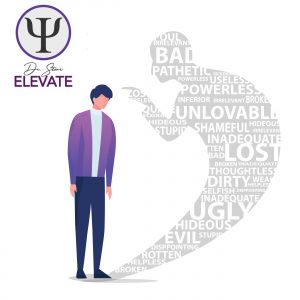
I had a very good friend who berated himself regularly and was incredibly self-critical. One night I remember having a conversation, and I shared with him that he is being bullied. He looked at me quite confused and responded with an amused ‘Huh?’. I however was completely serious and shared that he has been one of my closest friends for years, and if I ever saw anyone being this mean to him I would feel the desire to plot and scheme to defeat the enemy who was hurting my dear friend. But I was really stuck not knowing what to do, as the very person bullying him was himself.
His face fell in recognition of my words and I could see tears filling his eyes. I then instantly felt bad for bringing this up, because we were on a fun weekend away. So I lightened the mood a little by saying ‘it’s not like I can beat you up to make you stop?’ which did make him laugh. I also shared with him that I so wish he could see himself through my eyes and really appreciate all of the things that make him truly amazing.
I share this story as a beckon of hope. Since having this intimate moment, my friend used this as one of the catalysts to make more of an effort to be kinder to himself and start a journey of not only trying to like himself more but even love himself. I cannot believe his transformation since this initial conversation. He no longer berates himself, certainly not to the same extent, he treats himself with more respect, is more forgiving of his apparent flaws, and accepting of who he is as a person. He seems happier, and I could not be prouder of the bravery and hard work this has taken. I know that he feels he still has a long way to go, but he has committed to the journey, and that is what truly matters.
Loving Myself – that is Cheesy Hippy Stuff Clare!
Yes, I hear you on this one! The term ‘love yourself’ is banded around quite a bit, and can often evoke a gagging response for some. I hold my hands up to feeling this way myself years ago. However, my response was often to break down in hilarious childish laughter at the ridiculousness of this very concept. This is because I confused it with resignation, or thinking you are the best and not wanting to develop or better yourself in any way. What I didn’t realise is that this entirely misses the point.
Self-love is about developing an unconditional love for yourself, which means that ‘no matter what, I still love you’. It doesn’t mean turning a blind eye to mistakes. It means being able to forgive your mistakes, still love yourself, accept you are human, and figure out what you can learn from your experiences.
The other common misconception is that loving yourself means that you will turn into a person who is conceded and ‘full of themselves’. Again this is highly unlikely for a number of reasons. Loving yourself simply means that you consider your own needs, care for yourself, use more supportive and encouraging self-talk, and find value in your being.
I can only think of positive outcomes of self-love such as improved self-esteem, self-efficacy (belief in your abilities) and confidence. It does not make you more prone to becoming an egotistical megalomaniac who thinks they are the best thing since sliced bread! That would be quite an amazing jump if you are the type of person who already suffers from low self-esteem.
“You are allowed to be both a masterpiece and a work in progress” Sophia Bush
How Do I Build a More Loving and Compassionate Relationship with Myself?
I am hoping by this stage I have persuaded you of the benefits of developing a healthier and more caring relationship with yourself. So below are some thoughts and tips on how to start putting this into practice. I am not saying this is easy. I have been through exactly the same process as my friend in the story, so know from experience this does not happen overnight. But all it takes is a commitment and intention to love and be forgiving of yourself. Like learning any new skill, the key is practice, practice, practice.
- Low self-esteem can make this journey more challenging, because you may not feel good enough to be kind to yourself. But I would counter this by saying - Since when do we have to DESERVE kindness?! Surely everyone deserves some love and compassion in this world. Even if you don’t feel deserving of the love, just give it to yourself anyway and see what happens.
- Forgive your apparent flaws – see them as a part of what makes you who you are. Would you be you without them? Commit to trying to change if they are unhelpful to you, not because it is someone else’s expectation you have adopted.
- Make changes out of love for yourself – if you decide that you want to commit to a change then try and do so with the intention of a loving act and not one of hating who you are. (For example ‘I choose to go to the gym and get fit because I love my body and want it to be healthy’, as opposed to ‘I hate the way my body looks and need to force myself to go to the gym to change it so I can then like myself more’)
- Be your own cheerleader – think about your internal dialogue and how you speak to yourself. If you wouldn’t speak that way to a close friend that you love, then do not speak to yourself this way either. Try saying compassionate and encouraging statements to yourself daily. This is not just about changing your mindset and affirmations. Neuropsychology teaches us of the neuroplasticity of the brain, meaning that daily practice will adapt your brain chemistry so it gets easier to be more compassionate to yourself.
- What would my friend say – if you struggle with knowing how to be more loving to yourself, then perhaps imagine a kind friend who would want to support you and what they might say for inspiration?
- Catch your critic – be loving of your critic too. It is after all only trying to keep you safe or encourage you to make changes. But, as research and experience tell us, ‘the stick approach’ is not the most efficient at motivating people to make lasting changes. Don’t get me wrong it can work, but it erodes self-esteem in the process.
- Recognise your worth – there are so many areas of life where you add real value to the world and to others, even if you do not yet realise this. Perhaps keep a list daily of the things you appreciate about yourself, what you like about yourself, even ask close friends or family that you trust what they most value about you for ideas.
- Parent yourself - I know that I am instinctively the most compassionate version of myself when I am with my kids…. most of the time….when my patience hasn’t run out! I use this mode to my advantage when I catch myself being self-critical and judgemental. I take a breath, recognise and acknowledge my critic and instead act as a nurturing mother to myself. Giving the same care, love and compassion I would offer to my own children.
- Use a role model – if the parenting one above does not work for you, then think of the most compassionate person you can imagine (this can be someone you know, or a role model who is famous, or even a fictional character). Embody their essence and what makes them so loving and compassionate. Mimicking others, to begin with, is a helpful way of practising a skill if you feel unsure at the start.
- Remember that it is not about always being nice to yourself and letting yourself off the hook - sometimes being more loving to yourself also means denying impulses and desires, because you know that what you are denying yourself is something that is unhealthy or takes you away from the life you truly want to be living. Figure out what the true need is behind the desire and find creative ways of meeting this need in a healthier way. For example your desire for chocolate could really stem from a need for comfort, soothing, or just plain hunger. There are other ways to meet these needs.
- Have an accountability buddy – talking to a close friend who will challenge your self-critical talk and help to model raising you up rather than beating you down can be invaluable. We live in a culture where berating yourself is a form of humour and almost expected in some social circles. To break this cycle try and surround yourself with like-minded people to avoid being dragged back into self-loathing.
- Try daily self-compassionate meditations – there are many great apps out there with guided meditations. So all you need to do is sit and listen. 'InSight Timer' is one I highly recommend.
- Ask yourself what you need – a part of self-love is learning to attend to your own needs more. Recognise that because you are in fact human you do have needs too, and deserve to have your needs met.
- Speak to a professional – sometimes this stuff is just too difficult to do on our own, and we all need a helping hand or listening ear at different stages in our life. If you have chronic low self-esteem or just cannot engage in self-love as much as you would like, then consider if seeking support with this could be beneficial to you. It may help to explore what is holding you back.
Having a better relationship with yourself offers the greatest emotional security there is. If you can love yourself, then you are not dependent on another person’s love for your own happiness. Another person’s love will simply add to this as a wonderful bonus. This person also does not then feel the weight of responsibility for your happiness and can focus on their own contentment as a result.
One of the biggest advantages of developing a kinder and more loving relationship with yourself is that you will begin to thrive in many areas of your life as a result. You will feel happier and more content in general. You will have a positive impact on the people around you. You will inadvertently model this healthy internal relationship to your family, friends, children, colleagues, and so on, who are then more likely to adopt this as a result. This is the ripple effect at play again!
“Remember, you have been criticizing yourself for years and it hasn’t worked. Try approving of yourself and see what happens” Louise Hay

How to Overcome Your Fears and Find the Courage You Never Knew You Had
My daughter found this concept hilarious, the term ‘spread your wings and fly’. She took it so literally, as 7-year-olds do, and thought it insane that we encourage people to believe they can fly. To put it into context, she was listening to the R. Kelly song with this title, and was confused/entertained by the prospect of people trying to jump from hilltops and falling flat on their faces. Her childish giggle and imagery, I have to admit, did give me some sniggers. However, it did make me think about a more serious point.
Can you learn to fly?

The image you see here is indeed of myself, yes Dr Clare Stone, bungee jumping from a cable car in the Swiss Alps. My husband and children at the lakeside below watching and cheering me on. This is my desktop image and for good reason. Not only does it make me smile when I see this beautiful scenery, but it acts as a reminder of just what I am capable of. It reminds me that I am brave, that I am adventurous, and that when I set my mind to something I can really go for it. We all need to be reminded of this from time to time. BUT I am NOT FEARLESS! I chose to jump despite the fear. I didn’t let fear stop me from an experience I know I wanted to have.
Many people look at this photo and make this very assumption. Well actually, ‘Clare you are nuts’, is often the first response I get from my loving friends and family. Perhaps there is some Freudian Thanatos style death instinct at play here. Each to their own I say! But more importantly, I often have people comment that I must be fearless to do these things. Now is where I do my hearty laugh and almost choke on my sandwich.
I clarify to these misguided souls that each time my heart was pounding, blood pulsing through my body, I felt nauseous, dizzy, had to run to the loo multiple times, and at least 20 times asked myself ‘what the hell am I doing! Is it too late to escape! What are the chances if I hide in this corner they will forget I am here!, What if I fall to my death right in front of my children? Oh my goodness does this make me a bad mother? Am I being irresponsible?’
I will let you in on a little secret that very few people will be honest enough to admit. True bravery is not the complete absence of fear.
If you have no fear, then you have nothing to overcome. Courage means accepting that the fear is there, acknowledging there is a reason for it, yet still making the conscious decision to take action. Facing your fears can be difficult, however, this positive action will lead you closer to the life that you truly want. THAT, my friends, is true courage!
“Courage is not the absence of fear, but the triumph over it. The brave man is not he who does not feel afraid, but he who conquers that fear”. – Nelson Mandela
Can I also be very clear that I am not talking about blindly ignoring your fear! This could be at best unhealthy and impulsive, at worst potentially dangerous. Your fear is there for a reason. What I am suggesting is a different relationship with your fear, and not automatically holding back from something you want because you are afraid.
How to Develop a Different Relationship with your Fear
-
Understand the purpose of fear – then you will not hate it so much
What is fear? Fear is the emotion that our bodies experience as a warning that there is some kind of threat. This could include a physical threat, emotional, financial, relational, and the list could go on. Here is a revolutionary thought……..fear is not bad! It is trying to protect us, BUT sometimes it goes into overdrive, and rather than protecting us, it prevents us from living the life that we aspire to.
Fear is a useful human response – it alerts us to danger and encourages caution. We need fear. It motivates us but gone unchecked it can also be crippling.
-
Be thankful for the fear
Sounds ridiculous I know. But join me on this train of thought for a moment. Imagine the next time you feel fearful of something you want to do. Instead of wishing the fear away and despising its very existence, be grateful for that fear and the thoughts that come along with it.
A bit like an overbearing mother who tells their child – no you shouldn’t do that risky thing because..…..then follows a long list of all the things that could go wrong. The child gets annoyed and thinks ‘they just want to suck the fun out of everything’! But dig a bit deeper, why is the mum responding like that? Most likely because of their love for you and their desire to keep you safe. It doesn’t mean you should agree with their perspective, but you can appreciate that it comes from a place of love and care.
Our own fear is exactly the same. It is a mechanism that we really should appreciate because it tries its very best to keep us alive and safe. This is a basic human need. However, the downside is that it is not concerned with some of the higher levels needs for actualising your potential.
-
Note your caution and judge if it is realistic or not
Make a conscious decision to pay attention to your fear. Overcoming fear is not always about just ignoring it and putting it in a box. Try to make a rational decision about whether you are being realistic or not. Your fear is simply a messenger, but it is up to you to judge whether the information it is giving you is helpful or not. For example, if your fear is around a business decision, perhaps there are valid points here, and that the resolution is to take some things into account, or make some adaptations to your plans.
-
Keep risk in perspective
We all have differing levels of risk aversion. Some people are willing to take more risks than others. But one of the very things that often prevent us from living our dreams, or aspiring for greatness is our fear of risk. The biggest mistake we can make is confusing probability with possibility. Just because something is possible DOES NOT make it probable. When facing fears this becomes an essential distinction to be able to make. Possibility means it can happen, probability refers to how likely it is that something can happen. Pretty much everything in life is possible, but there are various degrees of possibility. Probability can feel heightened if it is a highly emotive or feared consequence you perceive. The key is to sit down in a calm state and think logically about it. As yourself the following questions about it:
- If I was a bookkeeper how would I work out the probability of this situation?
- Ask a supportive friend, who knows what you are trying to achieve, what they think
- What are the chances that the worst-case scenario would actually happen?
- Are there things you can do to prevent the worst-case scenario while still moving forwards?
- What is the most probable outcome of this?
- What are the best things that could happen if I just try?
- If the worst did happen, although it would be unpleasant, could I find ways to cope or move on?
- Is this really going to matter to me in a year, 5 years, 20 years time?
- What is the cost of listening to the fear and not continuing with my desired path?
-
Reframe the fear
Sometimes just the physical experience of fear can be overwhelming, and we choose to believe that it is our body’s way of steering us away from something. Sometimes it is not actually fear at all that we are experiencing, but anticipation or excitement. They create very similar reactions in the body which can be confusing. Instead of telling yourself ‘Oh I am so anxious/scared/nervous about this presentation’, try telling yourself ‘I can feel the anticipation’ or ‘I am excited’. Big difference. Reframe your fear as anticipation and consider it a healthy dose of caution.
-
Go for it!
There is a book I love in which the title really says it best; ‘Feel the Fear and Do it Anyway’ by Susan Jeffers. I recommend this book if this article has sparked an interest in you. Action is by far the best remedy for overcoming your fear. You don’t necessarily need to jump straight in the deep end. Take a stepped approach if you need to and break your challenge down into smaller more manageable chunks. Do practice runs if that helps? Ask a friend for support for your first attempt if this makes it easier. Taking small steps towards the life you want and the kind of person you want to be is better than staying paralysed or choosing a completely different path, which may feel safer, but does not take you where you want to go.
In summary. Feeling afraid is not the issue, it is how you choose to respond when faced with this. If you continue because you know this leads you towards the life you truly desire, then this is indeed brave. Even if this is over seemingly minor – going for that promotion you really want, ask that person out that you are attracted to, travelling on your own somewhere. There is real courage in going for what you truly want in life, despite how much it may also scare you.