
The Great ADHD Myth?: A psychologist’s perspective on what the programme got right – and what it dangerously missed
Short on time? Here are the key points
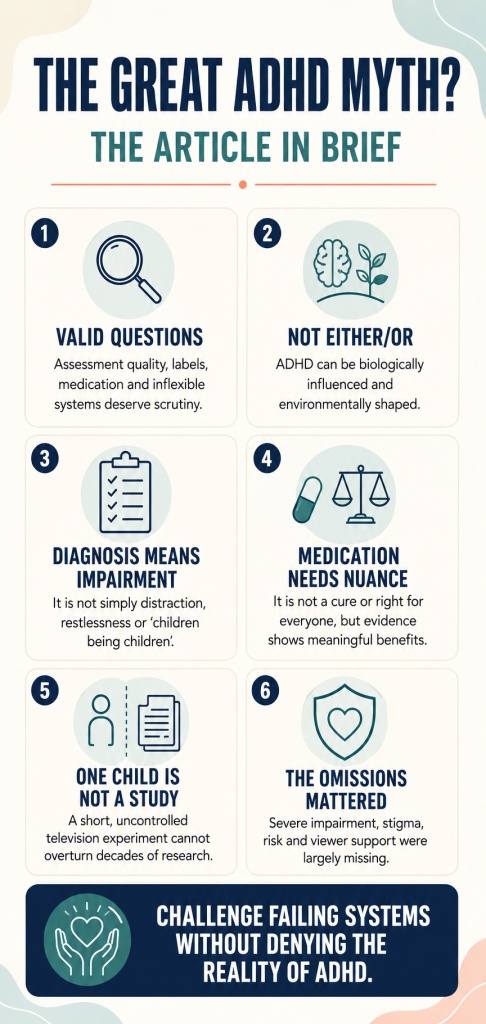
- The programme raised legitimate questions about assessment quality, diagnostic labels, medication, commercial interests, modern lifestyles and inflexible education systems.
- Those questions deserved balanced exploration. Instead, the programme repeatedly presented complex issues as either/or choices and ultimately declared that ADHD is not a neurodevelopmental condition.
- ADHD can be biologically influenced and environmentally shaped. Recognising the role of schools, workplaces, relationships and modern life does not make the underlying difficulties unreal.
- ADHD is not diagnosed simply because someone is distracted, restless or behaves like a child. Diagnosis requires a persistent developmental pattern and significant impairment across important areas of life.
- Medication does not cure ADHD and is not right for everyone. However, research shows that it can reduce core symptoms and may be associated with improvements in serious real-world outcomes. Decisions should be individualised and carefully reviewed.
- One child stopping medication while simultaneously changing his diet, screen use, exercise, outdoor activity and family routines cannot establish what caused any changes or overturn decades of research.
- The programme largely omitted people with severe ADHD-related impairment and provided no support signposting, despite the risk of increasing shame, stigma and distress.
The central message: We should scrutinise assessments, medication, commercial interests and the systems that fail neurodivergent people. We can do that without denying the reality of ADHD or invalidating those whose lives are significantly affected by it.
The Great ADHD Myth?: A psychologist’s perspective on what the programme got right – and what it dangerously missed
By Dr Clare Stone, Chartered Counselling and Coaching Psychologist
As a psychologist, I am trained not to accept claims uncritically simply because they are familiar, popular or expressed by someone in authority. Good psychological science requires curiosity, humility and a willingness to change our minds when the evidence changes.
I therefore did not object to Channel 4’s The Great ADHD Myth? because it asked difficult questions.
There are important questions to ask about the quality of ADHD assessments, the growth of private provision, financial interests in healthcare, the long waits for NHS care, the effects of receiving a diagnostic label, the role of medication and the extent to which schools and workplaces accommodate different minds.
What concerned me was the programme’s polarisation of these questions. Again and again, complex issues were presented as binary choices: biology or environment; neurodevelopmental condition or social construct; medication or lifestyle; helping a child learn or allowing them to be themselves.
The presenter, psychiatrist Dr Max Pemberton, concluded:
“I am now convinced it is a myth that ADHD is a neurodevelopmental disorder. Actually, I think it’s a set of difficult behaviours, a social construct. Not a disorder of the brain.”
This was not expressed tentatively as a personal interpretation or one position within a contested debate. It was delivered with striking certainty, as though the making of one television programme had overturned decades of genetic, developmental, clinical and neuroscientific research.
That use of medical authority is the aspect I found most troubling.
What the programme got right
A balanced response must acknowledge that several questions it raised are legitimate.
Assessment quality needs scrutiny
Not every ADHD assessment is necessarily of equal quality. Long NHS waits have created a market in which private providers vary in their experience, methods, professional composition and follow-up arrangements. Some people pay substantial sums only to discover that their report will not be accepted for prescribing or shared-care purposes. A rushed, questionnaire-led process risks both overdiagnosis and underdiagnosis.
A proper assessment is not simply a matter of recognising a few familiar traits. Many people lose things, procrastinate, become distracted or feel restless. Diagnosis requires a persistent developmental pattern, clinically significant functional impairment and difficulties across relevant settings. It should also consider alternative explanations and co-occurring conditions.
Pemberton paid £1,200 for a private online assessment and received a diagnosis that he rejected because he did not feel disabled or significantly impaired. We cannot judge the full assessment from an edited sequence. If impairment was not established, however, that raises a legitimate question about the quality of that particular assessment.
There is also another possibility worth considering. Intelligent, outwardly successful people can build substantial scaffolding around their difficulties: rigid systems, reminders, overpreparation, reliance on urgency or enormous compensatory effort. This can conceal impairment from others and sometimes from the person themselves.
Those strategies may work for years before increased responsibilities, stress, burnout or hormonal transitions overwhelm them. Many women, for example, describe previously effective coping strategies unravelling around perimenopause, although research into the specific relationship between ADHD and menopause remains emergent.
Diagnosis and labels can affect identity
The programme was also right to invite discussion about what happens psychologically when we give someone, particularly a child, a diagnostic label.
A diagnosis can become a framework for understanding and accessing support. It can relieve years of shame by replacing “lazy,” “badly behaved” or “not trying” with a more accurate account of why some things are difficult. But a label can also be absorbed as a fixed limitation. If communicated poorly, it may contribute to stigma, lowered expectations or learned helplessness.
When my own son was diagnosed, we followed the guidance of his educational psychologist and were careful about how we introduced this. We initially focused less on the diagnostic name and more on helping him understand that his brain worked in a particular way: some things were harder, some strategies could help, and none of this defined his worth or potential.
That is a valid concern for every diagnostic process. But it does not follow that diagnosis inevitably makes people stop trying or that accommodations “excuse” them from developing skills. Appropriate accommodations provide access. They reduce unnecessary barriers so that a person has a fairer opportunity to learn, participate and build skills. Support and personal agency are not opposites.
Medication decisions deserve honesty and compassion
Medication can have side effects. Appetite reduction, sleep disruption and changes in energy or emotional tone should not be dismissed. The teacher’s reflections in the programme were among its most humane moments: medication appeared to help the child engage with formal learning, but people around him also missed some of his playfulness and spontaneity.
That is a real and painful dilemma. Children are not collections of symptoms to be made more convenient for adults.
If someone feels emotionally flattened, “less fun” or unlike themselves, that matters. It may indicate that the dose, timing, formulation or medication should be reviewed. It may contribute to a decision not to medicate. Equally, some children report feeling calmer, more emotionally regulated and more able to sustain friendships while appropriately medicated.
The task is not to impose one answer on every family. It is to weigh benefits and costs for the individual, include the child’s experience, titrate carefully and review the decision over time.
Environment and modern life matter
Sleep, physical activity, nutrition, stress, routines, family support, time outdoors and patterns of screen use can all affect attention, mood and self-regulation. Modern life frequently fragments attention, while many children have less freedom to move, play outdoors and learn through varied activities.
There is evidence that exercise can improve inattention, inhibitory control and cognitive flexibility in children and young people with ADHD. Nature exposure can support attention and mood, although the evidence is more limited and does not establish it as a stand-alone treatment. These approaches are valuable because they can improve wellbeing and functioning, not because they disprove ADHD.
As both a psychologist and a parent, I am aware of the importance of limiting excessive gaming and screens, encouraging outdoor activity, supporting sleep, offering a healthy diet and trying approaches such as yoga. We have done these things with my son. They help, but they have not made his ADHD disappear.
I want to be clear. Families should not be left believing that continuing difficulties mean they have failed to provide the correct food, boundaries, exercise or parenting.
The system does need to change
On this, I agree wholeheartedly with the programme. Schools, workplaces and healthcare systems often fail to accommodate human variation. Support should not depend entirely on a diagnostic label, and medication should never substitute for adequate educational support, reasonable adjustments or psychologically informed care.
Many schools are structured around prolonged sitting, sustained attention, conformity and a narrow range of ways to learn or demonstrate ability. That will disadvantage many learners, with or without ADHD. We should create education systems with more movement, creativity, written and verbal instruction, manageable task lengths and different routes to participation.
But changing the education system and recognising a child’s neurodevelopmental needs are not mutually exclusive. The school environment can be problematic without the child’s difficulties being imaginary.
Where the programme became misleading
“Social construct” was used as though it meant “not real”
There is a limited sense in which ADHD, like diagnostic categories across medicine and mental healthcare, is socially constructed. Humans create the name, define the criteria and decide where a continuous distribution of traits becomes sufficiently impairing to justify diagnosis and intervention.
There is no line drawn by nature labelled “ADHD starts here.” The threshold is a clinical and social decision informed by research, values and the consequences of acting or not acting. Similar judgement is involved when medicine sets thresholds for hypertension, or when psychiatry determines when low mood becomes a depressive disorder.
But the fact that a category and its boundary are constructed does not mean that the underlying traits, distress, impairment, developmental patterns, genetic influences or group-level biological findings were invented by a committee.
The programme repeatedly collapsed those two propositions. It treated “neurodevelopmental” and “social” as mutually exclusive, when contemporary psychology understands people through interactions between biology, development, relationships, culture and environment.
Something can be biologically influenced and environmentally shaped. Its visibility and disabling impact can change with context without the underlying vulnerability being imaginary.
The World Health Organization classifies ADHD as a neurodevelopmental disorder in ICD-11. NICE, the NHS and the DSM-5-TR recognise it. The 2021 World Federation of ADHD International Consensus Statement drew together 208 empirically supported conclusions from large studies and meta-analyses, endorsed by 80 authors across 27 countries. Scientific consensus is not sacred, but overturning it requires evidence of comparable strength, not selective interviews, assertion and a single televised case.
A rise in referrals is not proof of a new epidemic
The programme emphasised how rare ADHD diagnoses once appeared and how sharply referrals and diagnoses have risen. Social media, greater public discussion and changing expectations have undoubtedly influenced help-seeking. Poor-quality information can encourage people to overidentify with ordinary traits, and systems that make support dependent on diagnosis can create additional incentives to seek one.
However, rising recognition and service demand are not the same as rising underlying prevalence.
The Government’s 2026 independent interim review reported that the number of children and young people waiting for an ADHD assessment in England rose from around 21,000 in April 2019 to around 270,000 by December 2025. Yet the best available population surveys suggest that the underlying prevalence of ADHD symptoms has been much more stable, with no evidence of a dramatic population-level increase over recent decades.
The review’s conclusion is more complex: relatively stable underlying prevalence can coexist with rapidly rising referrals, diagnoses and demand. Increased awareness, reduced stigma and improved recognition of groups historically missed; including girls, women and some minority group, can bring previously hidden need into view.
Some overdiagnosis, some misdiagnosis and substantial underdiagnosis can all exist simultaneously. This is precisely the kind of both/and thinking the documentary lacked.
Diagnostic manuals are imperfect tools, not inventions without evidence
Diagnostic systems deserve critical scrutiny. Categories change, thresholds involve judgement, and historical versions have contained serious cultural biases. They should never be treated as infallible maps of human experience.
However, portraying the DSM or ICD as though a few psychiatrists casually invented diagnoses around a table is misleading. These classification systems are not simply invented by a small group of psychiatrists. Their development and major revisions involve reviews of scientific evidence, multidisciplinary expert groups, professional and public consultation, and field testing. Proposed diagnostic criteria are scrutinised in relation to their validity, reliability, feasibility and clinical usefulness.
They are human-made and imperfect, but they are not simply “made up.”
“Diagnosing children for being children” misunderstands impairment
ADHD traits are continuously distributed. Everyone experiences distraction, impulsive moments or restlessness. That is not evidence against ADHD, any more than everyone experiencing sadness makes severe depression unreal.
Diagnosis is not based on the mere presence of recognisable behaviours. It asks whether they are developmentally atypical in their persistence or intensity, evident across settings, traceable to childhood and associated with significant functional impairment. The NHS explicitly notes that many children are distracted, impulsive and energetic and that this alone does not mean they have ADHD.
Presenting ADHD as “children being children” also risks reviving the idea that difficulties arise from permissive parenting or poor discipline. That is both inaccurate and stigmatising.
The presenter’s diagnosis raised questions but did not answer the programme’s thesis
Pemberton’s own ADHD assessment is interesting precisely because several explanations remain possible. The assessment may have been insufficiently rigorous. Functional impairment may have been underexplored or poorly communicated. Alternatively, he may have developed effective scaffolding that obscures difficulties. We cannot determine which from the broadcast.
Nor is it enough to assume that a highly intelligent and professionally successful person could only have mild ADHD. Success does not measure the effort, exhaustion or hidden cost required to maintain it.
The programme appeared to use his diagnosis to suggest that anyone who wants one can obtain one. That sweeping implication was unfair to people who approach assessment reluctantly after years of difficulty, often carrying considerable stigma and self-doubt.
His experience supports an argument for high-quality assessment and regulation. It does not demonstrate that the diagnosis itself is a myth.
The brain-imaging argument confused two different questions
It is true that ADHD cannot currently be diagnosed from an individual MRI scan. Professor Katya Rubia said this in the programme.
What does not follow is that ADHD therefore has no biological or neurodevelopmental basis.
Research can identify average differences between groups without those findings being consistent or precise enough to classify an individual. ADHD is heterogeneous: people meet criteria through different combinations of traits and have different developmental histories, compensatory strategies and co-occurring conditions.
The international ENIGMA mega-analysis of more than 3,200 participants found small group-level differences in several subcortical brain volumes, particularly in children. Large genetic studies have identified multiple regions of DNA associated with ADHD, including links to genes that are particularly active during early brain development. These findings do not provide a diagnostic scan or prove there is one uniform “ADHD brain.” They do contradict the claim that the absence of an individual biomarker proves an absence of biology.
Interestingly, after the broadcast, Professor Katya Rubia subsequently stated that her contribution had been “largely misrepresented”, with comments cherry-picked, truncated and presented out of context.
She clarified that although current brain scans cannot diagnose ADHD in an individual, this does not mean that ADHD has no neurobiological correlates. Three decades of neuroimaging research have identified average group-level differences in brain structure, function and connectivity. She also acknowledged that these differences are generally small and that ADHD is highly heterogeneous, meaning that not every person shows the same neurobiological pattern.
Both facts can be true: current scans cannot diagnose an individual, and credible group-level neurobiological evidence exists.
Neuroplasticity does not mean ADHD can simply be trained away
The brain is plastic. Learning, relationships, stress, practice, medication and environment can change neural pathways and behaviour. This is one reason psychological strategies, coaching, habit-building and adjustments can improve functioning.
But “the brain can change” does not mean that every inherited or developmental vulnerability can be erased through enough effort. Neuroplasticity is a capacity, not a promised cure.
Longitudinal studies following children with ADHD through adolescence and into young adulthood show that symptom severity and presentation can change, and often fluctuate, over time.
This does not mean that ADHD simply disappears: in one major 16-year study, sustained remission was uncommon, and many participants experienced a recurrence after a period of improvement.
Environment and learned strategies can alter how ADHD is expressed and how disabling it becomes. That is not evidence that lifestyle-driven neuroplasticity reliably removes it.
One child’s experience cannot overturn a research field
Mason’s story was emotionally engaging, but it was not a scientific experiment capable of answering whether ADHD exists.
Medication, screens, diet, supplements, exercise, nature exposure, structured activities and family attention all changed together. There was one child, no control group, no blinding and a short follow-up, all within the unusual context of being filmed for television. No causal conclusion can be drawn from that design.
The programme foregrounded the positive changes: Mason seemed happier, more playful and more socially engaged. Yet his teacher later described greater disruption, fidgeting and difficulty completing work. The brief end text revealed that he returned to medication and that his schoolwork improved. Viewers who looked away or switched off early could easily have missed the result that most complicated the programme’s narrative.
This does not prove every child should take medication. It shows that the attempted experiment did not support the sweeping conclusion drawn from it.
I also found myself wondering how Mason’s mother felt watching a programme in which she had participated ultimately declare that her child’s ADHD was a myth. I cannot know her view, but it highlights the ethical tension in using one child’s life as the narrative vehicle for a predetermined conclusion.
Medication does not need to “cure” ADHD to provide treatment
Pemberton argued that medication does not cure anything; it suppresses or controls symptoms. But many accepted medical treatments manage a condition rather than eliminate its cause. Asthma inhalers, antihypertensive medication and many treatments for chronic pain or mental-health conditions work while they are taken. That does not make them fraudulent or dystopian.
The relevant question is not whether medication permanently cures ADHD. It is whether it safely improves symptoms, functioning, autonomy, wellbeing and longer-term outcomes enough to justify its risks for that individual.
Randomised trials show that ADHD medication reduces core symptoms. Large observational studies associate treatment with lower rates of suicidal behaviour, substance misuse, transport accidents and criminality. A 2024 study found that medication initiation was associated with lower all-cause and unnatural-cause mortality during the following two years. Observational evidence cannot prove every benefit is caused by medication, but it directly challenges the claim that medication merely optimises compliant behaviour.
Medication is not right for everyone. NICE recommends implementing and reviewing environmental modifications first, then offering medication to children aged five and over, young people and adults when significant impairment persists. Treatment should be individualised rather than governed by ideology in either direction.
What the programme missed
The people most severely affected
Where were the adults unable to sustain employment despite enormous effort? Those overwhelmed by daily administration, unsafe impulsivity, debt or relationship breakdown? The people living with secondary anxiety, depression, addiction or profound shame? Those whose outward success depends on exhausting compensation and eventually ends in burnout?
Unsupported ADHD is associated with higher risks of educational failure, accidents, substance misuse, criminal-justice involvement, mental-health difficulties and premature mortality. This does not mean every person with ADHD experiences disability in the same way, but it makes dismissive framing consequential.
A programme asking whether ADHD is real should include the experiences most capable of challenging its preferred conclusion, including adults and people at the severe end of the spectrum.
The possibility of difference, disability and contextual strength coexisting
Some people understand their ADHD primarily through neurodiversity rather than disorder. Some experience contextual strengths and do not identify as disabled. This is where some ADHD-related traits can be helpful in the right circumstances. For example, intense focus, creativity, spontaneity or rapid thinking may be valuable in certain roles or environments, while those same traits may create difficulties in others. Others experience ADHD as profoundly disabling. Neither should be required to speak for everyone.
The right question is not simply “difference or disorder?” It is: what is this person experiencing, how is it affecting their life, what strengths and needs are present, and what combination of environmental, psychological, educational and medical support would improve their autonomy and wellbeing?
The potential harm – and the absence of support
The Royal College of Psychiatrists warned after the programme that invalidating a neurodevelopmental condition can fuel stigma and discourage people from seeking support and treatment.
For someone already wondering whether they are lazy, weak, badly behaved or making excuses, hearing a psychiatrist declare with certainty that ADHD is a myth can deepen shame. Parents may feel blamed. Employers and teachers may feel licensed to withdraw understanding. People may stop medication or abandon an assessment without seeking appropriate advice.
Having rewatched the programme and watched the end credits carefully, I could find no signposting to support for viewers who felt distressed or triggered. Given the well-established association between ADHD and increased rates of depression, self-harm and suicide, failing to provide even basic support signposting was not a minor oversight. In my view, it was a grave and inexcusable failure of responsibility towards the very people the programme knew, or should have known, could be deeply distressed by its content.
Conclusion: challenge the system, not the existence of the people it is failing
The programme was right that our systems need to change. It was right to question assessment quality, commercial incentives, overreliance on medication and educational environments that demand a narrow range of behaviour. It was right to show that medication decisions can involve real loss as well as benefit. It was right to ask what diagnostic labels do to identity.
But none of those points demonstrates that ADHD is a myth.
We can recognise that diagnostic categories have socially constructed boundaries while accepting that the phenomena they describe are real. We can value neurodiversity while acknowledging disability. We can improve nature access, exercise, diet, sleep, schooling and screen habits without pretending they reliably remove a highly heritable developmental condition.
We can scrutinise private clinics and pharmaceutical companies without treating every clinician as corrupt or every patient as a consumer purchasing an excuse. We can offer accommodations while still building skills and agency. We can use medication carefully without portraying it as either a miracle or punishment.
What I hoped to see was a genuinely critical programme: one that put controversial claims beside the strongest evidence against them, included researchers with substantial ADHD expertise, represented people across levels of impairment and allowed viewers to reach informed conclusions.
Instead, I saw a highly polarised, one-sided argument presented with the authority and appearance of a scientific investigation.
I believe it is legitimate to ask Channel 4 and the relevant professional regulator to consider whether appropriate evidential, editorial and professional standards were met. That is not to presume misconduct. It is to ask who is accountable when authoritative health communication may foreseeably cause harm.
The response since the broadcast has offered some hope. Psychologists, psychiatrists, neuroscientists, researchers, charities, advocates and people with lived experience have challenged omissions and stood beside those who felt invalidated. Professor Rubia has clarified that her contribution was taken out of context. ADHD UK has complained to Ofcom. The Science Media Centre has collated detailed responses from specialists in ADHD research and clinical practice.
That collective response matters. It tells people with ADHD, those awaiting assessment and those still trying to understand themselves:
You are seen. Your experiences are real. You are not standing alone.
Sources and further reading
- Science Media Centre: expert reaction to The Great ADHD Myth?
- ADHD UK: Challenging Channel 4’s The Great ADHD Myth?
- Channel 4 press release for The Great ADHD Myth?
- UK Government (2026): Independent review into mental health conditions, ADHD and autism — interim report
- NICE guideline NG87: ADHD diagnosis and management
- NHS: ADHD in children and young people
- Faraone et al. (2021): World Federation of ADHD International Consensus Statement
- Hoogman et al. (2017): ENIGMA mega-analysis of brain volumes
- Demontis et al. (2023): Genome-wide analyses identifying 27 ADHD risk loci
- Sibley et al. (2022): Variable patterns of remission from ADHD
- Vysniauske et al. (2023): Exercise interventions for children and adolescents with ADHD
- Dalsgaard et al. (2015): Mortality in people with ADHD
- Li et al. (2024): ADHD pharmacotherapy and mortality
- Zhang et al. (2025): ADHD treatment and real-world risks
This article offers general psychological information and commentary. Anyone considering changing or stopping ADHD medication should first speak with their prescriber.