

Confidence vs Competence: Why Capable People Still Doubt Themselves
(Reading Time approx 10 mins)
You don’t have to believe you can do something perfectly right now. Sometimes, confidence begins with trusting your ability to learn.
Have you ever found yourself questioning your abilities, despite having plenty of evidence that you’re actually quite capable?
Perhaps you’ve spent years building a successful career. You’re experienced, knowledgeable and good at what you do. Other people see you as capable, and you’ve worked hard to get where you are.
Then something changes.
You get promoted. You take on a new responsibility. You start a business. Or perhaps you find yourself doing something outside your usual comfort zone.
Suddenly, you’re second-guessing yourself, comparing yourself with others and wondering whether you’re actually as capable as everyone seems to think you are.
And perhaps the most uncomfortable part is that little voice telling you that, at this stage in your life or career, you really shouldn’t be feeling like this.
But there’s an important distinction we often overlook.
Being competent and feeling confident are not the same thing.
And perhaps even more importantly, we don’t necessarily need to feel confident in our current abilities to believe in our capacity to develop them.
Short on time? Here’s the key takeaway (1-minute read)
Confidence and competence aren’t the same thing. Competence is about what you can actually do; confidence is about what you believe you can do.
You can be highly skilled and still doubt yourself. Equally, you can feel confident without having developed the necessary skills.
But here’s the distinction I think matters most: you don’t have to be confident that you can do something right now. You can be confident in your ability to learn how.
This connects with the psychological concept of self-efficacy — our belief in our capacity to take the actions needed to achieve particular outcomes.
For high achievers, being a beginner can feel particularly uncomfortable. We become so accustomed to being capable that we forget we’re allowed to learn.
And confidence doesn’t always come before action. Often, it develops through practice, experience and discovering that we can cope with challenges.
The takeaway? Stop expecting yourself to feel like an expert when you’re still learning. You don’t need to know everything, get everything right or eliminate self-doubt before taking the next step.
Sometimes, the most useful form of confidence is simply trusting yourself to learn, adapt and grow.
Confidence vs competence: what’s the difference?
We often talk about confidence as though it’s a personality trait. Someone is either confident or they’re not.
But confidence is much more dependent on the situation than we sometimes recognise.
Competence is about our actual skills, knowledge and ability to do something. Confidence is about how much we believe in our ability to do it.
Psychologist Albert Bandura introduced the concept of self-efficacy, referring to our belief in our ability to organise and carry out the actions needed to achieve particular outcomes.
Importantly, self-efficacy isn’t simply about feeling generally confident. Our beliefs about what we can do can vary considerably depending on the task, the circumstances and our previous experiences.
You might be confident managing complex situations at work, but feel terrified at the thought of delivering a presentation. Or perhaps you’re an excellent professional who suddenly feels out of your depth when asked to manage a team.
This is where I find the confidence–competence matrix particularly helpful.
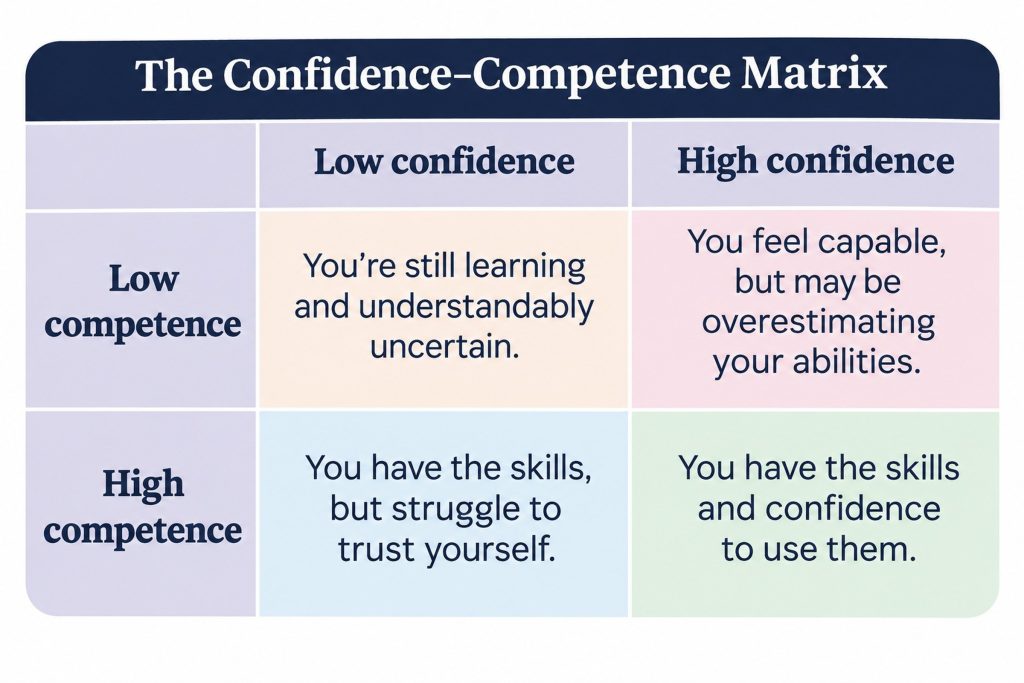
The confidence–competence matrix
This is a useful framework for reflection rather than a formal psychological assessment. In reality, confidence and competence exist on a continuum, and we can move between these positions depending on the situation.
But there’s something else worth considering.
You can have low confidence in your ability to perform a task right now, while still having strong confidence in your capacity to learn how.
And I think that’s an important distinction, particularly when we’re facing something unfamiliar.
Think back to when you first learned to drive
I think learning to drive is a useful example of how confidence and competence develop.
Think back to your first driving lesson.
You probably weren’t particularly confident. And actually, there was a good reason for that. You hadn’t yet developed the skills or experience needed to drive safely.
You were trying to remember everything at once. Mirrors, gears, steering, judging distances, watching other road users. Things that might now feel automatic required enormous concentration.
And imagine if you’d climbed into that car on your first lesson, absolutely convinced you were an excellent driver.
That confidence, without the competence to back it up, could have been dangerous.
But here’s where I think we need to make an important distinction.
You didn’t need to believe you were already a good driver.
You needed to believe that you could learn to become one.
You could recognise that you lacked the skills while still trusting that, with lessons, practice, feedback and experience, you could develop them.
And that’s a very different kind of confidence.
Of course, not everyone develops confidence at the same pace as competence. Some people continue to experience driving anxiety despite being highly skilled drivers.
But the principle is useful.
We don’t expect someone to feel like an experienced driver on their first lesson. So why do we sometimes expect ourselves to feel like an expert when we’re doing something new?
Perhaps instead of asking, Am I confident that I can do this?, we need to ask:
Am I confident that I can learn what I need to learn?
That doesn’t mean assuming we’ll succeed at everything we attempt. We may need time, support or a different approach.
But it allows us to recognise that our current abilities aren’t necessarily the limit of our future capabilities.
Why being a beginner can feel particularly difficult for high achievers
I think this becomes especially challenging when being competent has become an important part of how we see ourselves.
Perhaps you’ve always been the person who performs well, works hard and can be relied upon to find a solution.
Over time, that can become part of your identity.
So when you find yourself in a situation where you genuinely don’t know what you’re doing, it can feel like more than simply learning something new.
It can feel like a threat to your sense of who you are.
Instead of thinking, Of course I don’t know how to do this yet, you think, I should be better at this.
And if perfectionism is involved, the expectations can become even more unrealistic.
You don’t just want to learn. You want to be good at it immediately.
But being good at one thing doesn’t mean you should automatically be good at everything.
Perhaps the challenge is learning to separate your sense of capability from your current level of competence.
You can recognise that you don’t yet have the skills without concluding that you’re incapable of developing them.
Being a beginner doesn’t mean you’ve stopped being a capable person.
The higher you climb, the more confident you’re expected to appear
As we progress through our careers and take on greater responsibility, other people start looking to us for decisions, guidance and reassurance.
And with that comes an unspoken expectation that we should know what we’re doing.
That we should have the answers.
That we should be confident.
But here’s the contradiction.
The further we progress in our careers, the more likely we are to encounter situations we’ve never had to navigate before.
A promotion can take you from being highly competent in your previous role to suddenly having to learn an entirely different set of skills.
Yet because you’ve reached a certain level of seniority, it can feel as though you’re no longer allowed to be a beginner.
If I ask for help, will they think I’m not capable?
What if they realise I’m not as good as they think I am?
Suddenly, confidence becomes less about how capable we actually are and more about how capable we feel we need to appear.
And that can create an exhausting cycle of overpreparing, second-guessing and trying to make sure nobody sees our uncertainty.
But perhaps genuine confidence in leadership isn’t about knowing everything.
Perhaps it’s about trusting your capacity to learn, make decisions, seek advice and respond when things don’t go to plan.
The additional pressure on women
For women in particular, there can be another layer of complexity.
Research into gender and leadership has highlighted some of the contradictory expectations women can face.
Eagly and Karau’s role congruity theory describes how traditional expectations associated with women can conflict with those associated with leadership.
Women may be expected to demonstrate authority and assertiveness while also remaining approachable, collaborative and likeable.
Related research by Rudman and Glick has explored how women displaying assertiveness can sometimes experience negative social evaluations.
These experiences aren’t universal, but they help explain why some women can feel they’re walking a particularly difficult tightrope.
Too little confidence, and they worry about being perceived as lacking leadership potential. Too much confidence, and they worry about being judged as arrogant or difficult.
And underneath all of that, they might simply be trying to learn how to do a new job.
Perhaps we need to rethink what confident leadership actually looks like.
There’s strength in being able to say, I haven’t encountered this before, but I’m confident we can work through it.
Or simply, I don’t know the answer to that yet. Let me find out.
Confidence doesn’t have to mean pretending you know everything.
The confidence we see isn’t always the confidence people feel
I think social media has made our expectations around confidence even more unrealistic.
We’re constantly exposed to people who appear confident, articulate, polished and successful.
They speak effortlessly into cameras, deliver presentations and seem to know exactly what they’re doing.
And it’s very easy to look at them and think, Why can’t I do that?
But we’re seeing one moment in somebody else’s journey.
We don’t see the years of practice, the uncomfortable first attempts, the mistakes or the times they questioned themselves.
And we certainly don’t know how confident they actually feel.
Someone can appear incredibly confident while experiencing significant anxiety.
I know this because, in many ways, I’ve been that person.
I wasn’t always confident speaking in front of people
Something I’ve shared recently with a client is that people looking at me now might reasonably assume I’m a fairly confident person.
I’m a psychologist. I deliver training, facilitate groups and increasingly put myself out there publicly through writing, social media and other opportunities.
But what people don’t necessarily see is how much work has gone into getting to this point.
And some of it still terrifies me.
Putting myself out there on social media has been a real challenge.
I’ve struggled with hearing my own voice, watching myself back and being overly critical of how I look and sound.
I’ve compared myself with other professionals who seem more articulate, intelligent, attractive or polished.
I’ve watched someone explain something brilliantly and thought, Why can’t I communicate like that?
And I’ve had to work hard at recognising that those thoughts aren’t necessarily an accurate reflection of my abilities.
But this isn’t new for me.
Early in my career, after finishing my degree, I worked as a college lecturer.
I wanted to teach. It was something I was genuinely interested in doing.
There was just one fairly significant problem.
Public speaking absolutely terrified me.
At the time, I was still living with my parents, and my dad worked in Glasgow, so I would often get a lift with him in the morning.
I can remember some mornings being curled up in the passenger seat, feeling physically sick with anxiety about having to stand in front of a class.
Sometimes I actually was sick.
That’s how intense the anxiety was.
Now, fast-forward to today.
I regularly stand in front of groups, deliver training and speak publicly as part of my professional work.
Do I still experience nerves?
Absolutely.
There are still situations that stretch me outside my comfort zone, and I still experience anticipatory anxiety.
But it’s nowhere near the level it was back then.
So what changed?
Primarily, I practised.
I developed skills. I gained experience. I learned what worked and what didn’t. I made mistakes, reflected and improved.
And gradually, I developed more trust in my ability to cope.
But I think there’s another part to this.
Somewhere along the way, I also developed more trust in my ability to learn.
When I face something unfamiliar now, I can draw on previous experiences of having struggled, practised and improved.
I don’t necessarily believe I’ll be brilliant at something straight away.
But I have more evidence that I can develop the skills I need.
My confidence isn’t simply in what I can do today. It’s also in my ability to grow beyond where I am today.
And I think that’s something we often overlook.
What if confidence comes after action, rather than before it?
I’ve been reading Russ Harris’s book The Confidence Gap, which draws on Acceptance and Commitment Therapy (ACT), and I think it offers a really helpful perspective.
We often approach confidence as though it’s a feeling we need before we’re able to do something.
I’ll apply for that job when I feel more confident.
I’ll start putting myself out there when I stop worrying about what people think.
I’ll take that opportunity when I’m ready.
But what if we’re waiting for something that can only develop through experience?
One of the central ideas in ACT is that we don’t necessarily need to eliminate uncomfortable thoughts and feelings before taking meaningful action.
Instead, we can learn to make room for anxiety, self-doubt and uncertainty while still moving towards things that matter to us.
This doesn’t mean ignoring our feelings or forcing ourselves into situations we’re not ready for. And it certainly doesn’t mean pushing through overwhelming anxiety without considering what support we might need.
It’s about recognising that discomfort isn’t always a sign that something is wrong.
Sometimes it’s part of doing something unfamiliar, challenging or important.
And perhaps this is where confidence in our capacity to learn becomes particularly valuable.
I don’t need to believe that I can do something brilliantly right now.
I can recognise that I’m learning, allow myself to feel uncomfortable and still take a manageable step towards developing my skills.
I can doubt my current ability without doubting my potential to improve.
And I can stop making confidence in my current performance a prerequisite for taking action.
Confidence doesn’t mean knowing you’ll get everything right
Another misconception worth challenging is the idea that confidence means believing we’ll perform perfectly.
For people with perfectionistic tendencies, this creates an impossible standard.
If confidence means being certain I’ll never stumble over my words, make a mistake or receive criticism, then of course I’ll struggle to feel confident.
Because none of us can guarantee those things.
A more helpful understanding might be trusting ourselves to respond to whatever happens.
When I deliver training now, I don’t need to believe that every word will come out perfectly.
Sometimes I’ll lose my train of thought. Someone might ask a question I don’t immediately know the answer to.
But I’ve learned that I can usually manage those moments.
And if something doesn’t go particularly well, I can reflect and improve next time.
Confidence doesn’t have to mean trusting yourself to be perfect. It can mean trusting yourself to cope, learn and adapt when things aren’t perfect.
Five ways to start building confidence
Bandura’s research into self-efficacy identifies mastery experiences as an important source of our beliefs about our abilities.
In other words, confidence can develop through doing, learning and experiencing ourselves managing challenges.
- Recognise whether you need confidence, competence or both
Are you genuinely lacking skills in this situation, or do you have the necessary abilities but struggle to trust yourself?
If you’re new to something, perhaps you need training, practice or experience.
If you’re already competent, perhaps the work involves recognising your strengths or changing how you respond to self-doubt.
And remember that you can have confidence in your ability to learn even when you’re not yet confident in your ability to perform.
- Stop comparing your beginning with somebody else’s middle
When you see someone doing something brilliantly, remember that you’re probably not seeing the whole story.
We wouldn’t compare someone on their third driving lesson with someone who’s been driving for 20 years and conclude that the learner was inadequate.
Yet we do exactly that to ourselves in other areas of life.
- Make room for discomfort
Instead of asking, How do I get rid of this anxiety?, try asking:
Can I allow this feeling to be here while I take one manageable step?
You don’t need to like the feeling or convince yourself everything will be fine.
The aim isn’t to overwhelm yourself. It’s to develop greater flexibility in how you respond to discomfort.
- Focus on learning rather than proving yourself
If the only outcome you’ll accept is doing something brilliantly, you’re making learning much harder.
Instead of I need to deliver a perfect presentation, perhaps the goal becomes I’m going to practise communicating my ideas.
Shift your attention from demonstrating competence to developing it.
- Build evidence that you can learn and cope
After trying something difficult, reflect on what went well, what you managed and what you learned.
Think about other situations where you’ve started with little experience and gradually developed your abilities.
Those experiences can remind you that being uncertain now doesn’t mean you’ll always feel that way.
You don’t have to become a different person to become more confident
Confidence doesn’t necessarily mean becoming louder, more outgoing or more polished.
It doesn’t mean eliminating self-doubt or becoming someone who never feels anxious.
Sometimes confidence is much quieter than that.
It’s allowing yourself to be inexperienced.
It’s asking a question when you don’t know the answer.
It’s speaking up even though your voice feels a little shaky.
It’s recognising that you don’t yet have the skills for something, but trusting that you can work towards developing them.
When I think back to that younger version of myself, curled up in the passenger seat on the way to teach, I don’t see someone who was incapable.
I see someone who was frightened, inexperienced and trying to do something that mattered to her.
And I wish she’d known that she didn’t need to feel confident in her ability to stand in front of that class and deliver a brilliant lesson.
She needed opportunities to learn, the right support and some compassion for herself along the way.
Because confidence isn’t always something we find before we take the next step.
Sometimes it’s something we build by taking that step, learning from the experience and gradually discovering what we’re capable of.
And perhaps the next time you find yourself questioning your confidence, the question isn’t simply, Why am I not more confident?
Perhaps it’s:
Am I expecting myself to feel like an expert when I’m still learning?
And can I trust myself to learn, even when I don’t yet know how?
How coaching psychology can help
If self-doubt, perfectionism or a lack of confidence is holding you back, coaching psychology can provide a space to explore what’s happening beneath the surface.
Sometimes the challenge is developing new skills. Sometimes it’s recognising and trusting the abilities you already have. And sometimes it’s developing greater confidence in your capacity to learn, adapt and respond to uncertainty.
As an HCPC-registered Counselling Psychologist and Chartered Coaching Psychologist, I draw on evidence-based approaches to help people understand these patterns, develop psychological flexibility and take meaningful steps towards their goals.
Find out more about coaching psychology at Dr Stone Elevate or get in touch to arrange a free discovery call.
References and further reading
- Bandura, A. (1977). Self-efficacy: Toward a unifying theory of behavioral change. Psychological Review, 84(2), 191–215. https://doi.org/10.1037/0033-295X.84.2.191
- Bandura, A. (1997). Self-Efficacy: The Exercise of Control. W. H. Freeman.
- Eagly, A. H., & Karau, S. J. (2002). Role congruity theory of prejudice toward female leaders. Psychological Review, 109(3), 573–598. https://doi.org/10.1037/0033-295X.109.3.573
- Harris, R. (2010). The Confidence Gap: From Fear to Freedom. Trumpeter.
- Rudman, L. A., & Glick, P. (2001). Prescriptive gender stereotypes and backlash toward agentic women. Journal of Social Issues, 57(4), 743–762. https://doi.org/10.1111/0022-4537.00239