

Do I Need an ADHD Diagnosis? Pros, Cons and Next Steps
Estimated reading time: 10–12 minutes
Do I need an ADHD diagnosis? The quick answer
- An ADHD assessment may be worthwhile if you want to explore medication, need formal evidence, want other explanations carefully considered or feel that diagnostic clarity would be personally important.
- It may be less urgent if a diagnosis would not change your next steps and you can already access the understanding, adjustments or ADHD-informed support you need.
- Diagnosis can bring relief, validation and self-compassion, but it can also bring grief, stigma and questions about identity.
- Support at work or school can sometimes be provided according to need without a formal diagnosis, although a diagnosis may make those needs easier to communicate.
- Screening questionnaires can indicate that ADHD is possible, but they cannot confirm it. Only a comprehensive assessment by an appropriately qualified professional can do that.
If you are still unsure where you fit, the fuller discussion below will help you weigh it up.
Do I need an ADHD diagnosis?
If you suspect you have ADHD, it can feel as though there is one obvious next step: get assessed and find out for certain.
For some people, a formal ADHD diagnosis is life-changing. It can replace self-blame with an explanation, open access to treatment and help someone communicate their needs. For others, assessment may involve a long NHS wait or substantial private expense without changing the support they can access.
So perhaps the most helpful question is not simply:
“Do I have ADHD?”
It may be:
“What would a formal ADHD diagnosis help me to understand, access or change?”
As a psychologist, and as someone whose family has made three different decisions about ADHD assessment, I do not believe there is one right answer. This article explores the potential benefits and drawbacks so you can make an informed decision.
What does an ADHD assessment actually establish?
ADHD is a neurodevelopmental condition involving persistent patterns of inattention and/or hyperactivity and impulsivity. Many people experience some of these traits, particularly when stressed, sleep-deprived or overwhelmed. A diagnosis requires more than recognising yourself in a list.
NICE guidance states that ADHD should be diagnosed by an appropriately qualified professional with specialist expertise. Assessment considers:
- whether the traits began in childhood and have persisted;
- how they show up across important areas of life;
- whether they cause at least moderate impairment;
- developmental and mental health history;
- information from other people where appropriate; and
- other possible or coexisting explanations for the difficulties.
ADHD symptoms need to occur in at least two important settings, such as home, work, education or relationships. A screening questionnaire can be a useful indication that further assessment may be worthwhile, but NICE is clear that rating scales alone cannot diagnose ADHD.
Concentration, memory, motivation and emotional regulation can also be affected by anxiety, depression, trauma, sleep or physical health problems, hormonal changes and sustained stress. A good assessment should build an accurate understanding of the whole person, not simply confirm a predetermined answer.
The potential benefits of an ADHD diagnosis
- It can provide an explanation and reduce shame
Many adults reach assessment after years of describing themselves as lazy, chaotic, careless, too sensitive or inconsistent. Diagnosis can offer a different explanation: they were trying to function without understanding what their brain needed.
A 2026 systematic review of 21 studies found that adult diagnosis was often a pivotal identity event. It could increase self-understanding and self-compassion, while also bringing grief, anger or confusion.
For high-achieving adults, external success may hide the effort required to maintain it. Someone can appear calm and organised while paddling furiously underneath. Perfectionism, over-preparation, rigid routines and working late may conceal genuine difficulties until increased demands or burnout make those systems unsustainable.
- It can open access to treatment
For people considering ADHD medication, formal diagnosis is an important gateway. NICE recommends that medication is initiated only by a professional with relevant expertise following appropriate assessment. Medication is not right for everyone, but some people experience meaningful benefits.
Diagnosis can also lead to psychoeducation and psychological support. NICE recommends a structured, ADHD-focused psychological intervention for adults when non-medication treatment is indicated, potentially including CBT. Ideally, diagnosis leads to a useful plan, not simply a label.
- It may make educational or workplace needs easier to communicate
A diagnostic report can give language and credibility to needs that have been misunderstood. It may help explain why written instructions, reduced distraction, protected focus time or greater flexibility improve functioning.
However, diagnosis is not always legally required before support can be provided.
In employment, Acas confirms that a worker does not need a diagnosis to be considered disabled under the Equality Act 2010. The legal focus is the substantial, long-term impact of an impairment. A diagnosis can strengthen the evidence, but it does not create the need.
In Scottish education, additional support is intended to be needs-led. The Scottish Government's statutory guidance states that a formal diagnosis is not required. In practice, families can still find that diagnosis makes it easier to secure consistent recognition and planning.
- It can identify needs that were previously hidden
A thoughtful assessment can reveal the difference between what someone achieves and what that achievement costs them.
This is particularly relevant for women and girls. Research has highlighted more subtle or internalised presentations, gender bias and compensatory strategies that can mask ADHD. An expert consensus statement on females with ADHD warns that these factors can delay recognition, while a systematic review of adult women identified themes including social-emotional harm, lack of control and greater self-acceptance after diagnosis.
Hormonal changes may influence symptoms for some women, although the evidence should not be overstated. A 2025 systematic review found suggestive links, particularly around puberty and the menstrual cycle, but the studies were few and varied; evidence specific to perimenopause remains limited.
The possible drawbacks of seeking an ADHD assessment
- It can be expensive, slow or difficult to access
NHS pathways vary across the UK and between local services. Referral criteria may prioritise greater impairment, while waits can extend for years. NHS England's ADHD Taskforce has called for needs-based support before diagnosis and for people who do not meet the clinical threshold.
Private assessment can be faster, but the advertised fee may not be the full cost. Medication can bring additional prescribing, titration and review charges. Shared care is not automatic, so speak to the provider and your GP before assuming primary care will later prescribe.
Spending a significant sum may be worthwhile if diagnosis is likely to unlock something important. It may feel far less worthwhile if it would provide confirmation but no meaningful change.
- Diagnosis can bring grief as well as relief
Later diagnosis can prompt painful questions: What might have been different if somebody had noticed earlier? Were years of criticism avoidable? Which parts of my identity are me, and which are ADHD? Research describes diagnosis as both validating and potentially destabilising. Good post-diagnostic support therefore matters.
- Stigma and misunderstanding still exist
Diagnosis can help other people understand, but it does not guarantee that they will. Some adults encounter dismissive comments, assumptions that ADHD is an excuse, or accusations that the diagnosis has been suggested or exaggerated by somebody else.
There may also be difficult decisions about disclosure. You do not have to tell everyone, but accessing some support may require sharing relevant information. Consider who needs to know and what boundaries you want around it.
- A label can become too narrow if it is not handled well
A diagnosis should expand understanding, not reduce a person to a list of deficits.
If ADHD is presented only through a medicalised, deficit-focused lens, someone may begin to view every difficulty as fixed or assume that change is impossible. Equally, a strengths-only account can minimise very real disability and distress. The most helpful position holds both truths: ADHD can create genuine impairment, and people can still build skills, shape their environments, use their strengths and retain agency.
Reasonable adjustments are not “making excuses”; they reduce avoidable disadvantage. Support also works best alongside curiosity about what the person can influence, practise or structure differently.
- Diagnosis may not alter what you do next
Many ADHD-informed strategies are useful regardless of diagnostic status: external reminders, written instructions, realistic planning, body doubling, fewer distractions and breaking tasks into visible steps.
If you do not want medication, do not need formal evidence and can already make helpful changes, assessment may not be your priority. That does not make your difficulties unreal.
Three different decisions in one family
My own family illustrates why I do not see assessment as an automatic yes or no.
Why private assessment was worthwhile for my son
When my son was struggling, most of the visible impact was at home. School did not initially recognise the extent of his difficulties, so an NHS referral seemed unlikely and would probably involve a substantial wait.
We invested in a private assessment, and I am very glad we did. Diagnosis helped us communicate his needs, contributed to a learning plan and guided support from an educational psychologist. Most importantly, it helped us protect both his learning and emotional wellbeing.
Scottish schools should provide support according to need rather than diagnosis. Nevertheless, our lived experience was that the diagnosis made those needs easier to explain and harder to overlook.
Why late diagnosis mattered for my husband
After my son's diagnosis, I learned more about ADHD's strong genetic contribution. A major review of twin studies estimated heritability at around 74%. That does not mean that 74% of a person's ADHD is “caused by genes”, or that a child has a 74% chance of having an ADHD parent. It is a population-level estimate.
Family clustering is nevertheless substantial. In one small clinical sample, ADHD symptoms occurred in 41% of mothers and 51% of fathers of children with ADHD. These are not universal estimates, but they illustrate why a child's diagnosis often prompts parental recognition.
That was our experience. I began seeing some of my husband's longstanding difficulties differently. Despite being a psychologist and knowing him for more than two decades, I had not recognised them as ADHD-related. He had largely managed until an exceptionally stressful period overwhelmed his coping systems.
Assessment then had a clear purpose. Diagnosis supported workplace adjustments and allowed him to trial medication, which he found improved his focus.
It was helpful, but it was not uncomplicated. Alongside greater understanding came grief, stigma and some deeply insensitive reactions from others. A diagnosis can change the lens, but it cannot instantly change the culture around the person.
Why I have not pursued assessment for myself
I identify strongly with many ADHD traits, and screening questionnaires have reinforced that it is a reasonable possibility. But I am not formally diagnosed, and screening is not the same as diagnosis.
Learning about less visible presentations in women created many light-bulb moments. I had thought of myself as naturally organised, but now wonder whether organisation became a way of preventing things from falling apart. I was studious, yet often felt I had to work much harder than others to retain information or achieve the same result.
I have still decided against assessment for now.
I do not currently want medication. I run my own practice, giving me freedom to shape my environment, and my employed workplace supports needs-based adjustments. A private diagnosis would therefore be a significant investment without clearly opening a door I need opened.
Self-understanding, practical scaffolding and ADHD-informed coaching feel sufficient just now. That is a personal cost-benefit decision, not necessarily a permanent one.
How to decide whether an ADHD assessment is worth it
You may find it helpful to ask yourself:
- How much are these difficulties affecting my life? Consider work, relationships, health, self-esteem and the hidden effort required to keep functioning.
- What would diagnosis give me access to? Medication, specialist treatment, formal evidence, educational planning or clearer workplace conversations may make assessment more valuable.
- Would clarity change my decisions? For some people, knowing matters deeply; for others, informed uncertainty is manageable.
- Do I want other explanations considered? Quality assessment should explore overlap and coexisting conditions.
- Can I manage the total cost? Include follow-up, medication and review, not only the assessment fee. There is also the potential ongoing cost of monthly medication, dispensing and regular psychiatry reviews if shared care is not agreed.
- Am I prepared for any outcome and its emotional impact? A proper assessment is an investigation, not a guaranteed diagnosis.
- Could I begin useful changes now? You need not wait before making your environment kinder to your brain.
What to check before paying for a private ADHD assessment
Before committing, ask the provider:
- Who will conduct the assessment, and what professional qualifications and ADHD-specific expertise do they have?
- Does it follow NICE guidance and include a full developmental, clinical and psychosocial history?
- How will they gather evidence across different settings and, where appropriate, from someone who knows you well?
- How do they consider other possible or coexisting conditions?
- What report and post-diagnostic discussion are included?
- If medication is relevant, who will prescribe and oversee titration?
- What are the complete costs for assessment, follow-up and medication reviews?
- What happens if your GP does not accept shared care?
A brief questionnaire followed by a guaranteed answer is not a comprehensive diagnostic assessment.
You are allowed to support yourself before you are certain
You do not need a diagnosis to notice patterns, reduce unnecessary demands or test helpful strategies. You can use external structure, request clearer communication, protect focus time and seek psychological or coaching support for the difficulties you experience.
At the same time, self-identification should not be confused with clinical certainty. If your difficulties are significant, worsening, affecting safety or mental health, or could have several explanations, professional assessment is important.
An ADHD diagnosis can be validating, protective and transformative. It can also be expensive, emotionally complicated and of limited practical benefit at a particular time. The best decision is not the one that proves your difficulties are legitimate; they already deserve attention. It is the one most likely to help you understand yourself, access what you need and live more sustainably.
If you are a high-achieving professional who suspects ADHD and is struggling with overwhelm, inconsistent performance, perfectionism or burnout, ADHD-informed psychological coaching can help you understand your patterns and build practical, personalised strategies, whether you have a formal diagnosis or not.
This article provides general information and is not a substitute for individual medical or diagnostic advice. If you are considering assessment or medication, speak with an appropriately qualified healthcare professional.
Evidence and further reading
- NICE: Attention deficit hyperactivity disorder—diagnosis and management
- Acas: Reasonable adjustments for neurodiversity
- Scottish Government: Supporting Children's Learning—Code of Practice (2026)
- NHS England: ADHD Taskforce
- McGill et al. (2026): Systematic review of experiences of adult ADHD diagnosis
- Attoe & Climie (2023): Systematic review of ADHD in adult women
- Young et al. (2008): Psychological impact of receiving an adult ADHD diagnosis
- Faraone & Larsson (2019): Genetics of ADHD
- Starck et al. (2016): Occurrence of ADHD in parents of children with ADHD
- Young et al. (2020): Expert consensus on ADHD in girls and women
- Eng et al. (2025): Systematic review of ADHD and sex hormones in females

Rising ADHD Diagnoses Do Not Mean ADHD Is a Fad: What the 2026 Government Review Found
It has become almost impossible to talk about ADHD without someone asking whether it is being overdiagnosed, whether “everyone has it now”, or whether it is simply the latest mental health fad.
The number of people seeking an ADHD assessment has certainly risen. More adults are being diagnosed, and ADHD has become far more visible in the media and on social platforms. But does that mean ADHD itself is suddenly becoming more common?
A major independent review published by the UK Government in March 2026 offers a much more thoughtful answer.
The short version is this: ADHD diagnoses and referrals have risen sharply, but the best available evidence does not show a dramatic rise in the underlying prevalence of ADHD.
That distinction matters. It challenges the simplistic idea that the increase in diagnoses must mean ADHD has become fashionable, while also recognising that the full picture is complex and that good-quality assessment remains essential.
What did the 2026 ADHD review examine?
The Independent review into mental health conditions, ADHD and autism was published by the Department of Health and Social Care on 31 March 2026. It is an interim report, focused on England, with final conclusions and recommendations still to come.
Rather than simply counting how many people now have an ADHD diagnosis, the review separates three things that are often wrongly treated as though they mean the same thing:
| What is being measured? | What does it tell us? |
| Population prevalence | How common ADHD appears to be across the wider population, including people who have never sought help or received a diagnosis |
| Recorded diagnosis | How many people have ADHD formally recorded within health systems |
| Referrals and service demand | How many people are seeking assessment or support, and the pressure this places on services |
These figures can move in very different ways. A rise in recorded diagnoses does not automatically mean that the condition itself has suddenly become more common.
So, is ADHD actually on the rise?
The report states that:
“The available evidence does not suggest a dramatic increase in the underlying population prevalence of ADHD.”
Population studies suggest that ADHD prevalence has remained relatively stable over time. The report uses broad estimates of around 5% in children and young people and 2% to 3% in adults. The evidence therefore supports the conclusion that there has not been a dramatic population-level rise, rather than suggesting there has been no change at all.
It is also important not to overstate what this interim report can tell us. England still lacks a recent, large-scale diagnostic study of adult ADHD in a representative population. Recent population data for children is also limited, and routine health records do not tell us enough about the severity or functional impact experienced by those being diagnosed. The findings are therefore important, but still provisional.
At the same time, recorded diagnoses, referrals and waiting lists have increased substantially, particularly since 2020.
Perhaps the clearest indication of the pressure now facing services is the growth in waiting lists. NHS England monitoring data cited in the review shows that the number of open referrals for children and young people awaiting an ADHD assessment rose from approximately 21,000 in April 2019 to around 270,000 by December 2025. That is more than a twelvefold increase in fewer than seven years.
This does not demonstrate that the underlying prevalence of ADHD has increased twelvefold. Waiting-list figures reflect growing recognition, referrals, access to assessment and the capacity of services to meet demand. What they do demonstrate is the scale of unmet need within the current system.
These patterns are not necessarily contradictory. A condition can remain relatively stable within the population while becoming more visible as recognition and help-seeking improve. The review considers improved recognition to be one likely contributor, alongside wider social pressures, pandemic-related changes, institutional factors and the possibility of changes in diagnostic thresholds.
Think about how our understanding of ADHD has changed. For many years, it was largely associated with visibly hyperactive boys. People whose difficulties appeared as disorganisation, chronic overwhelm, mental restlessness, emotional dysregulation, forgetfulness or inconsistent performance were much easier to miss.
Some adults develop extensive ways of compensating, such as overpreparing, creating rigid organisational systems, holding themselves to perfectionistic standards or relying on intense deadline pressure to get things done. Anxiety can become closely entangled with these strategies. From the outside, they might appear capable. Internally, the effort required can be enormous.
Greater awareness has not created these difficulties. It has given more people a possible explanation for struggles they may have carried for decades.
Why are ADHD diagnoses increasing, especially among women?
One of the report’s clearest findings is that the growth in diagnosis has been particularly marked among adolescent girls and young adult women.
It would be easy to present that as evidence of a new trend. Yet women and girls are also among the groups historically most likely to have been overlooked. NICE advises that ADHD is thought to be under-recognised in girls and women, while a systematic review of ADHD in adult women identified less overt presentations and compensatory strategies as factors that can contribute to delayed recognition.
The report identifies several factors that may be contributing to rising diagnoses at the same time:
- improved recognition of ADHD in previously underdiagnosed groups
- greater public awareness
- changes in help-seeking behaviour
- pressures and changes following the pandemic
- social and institutional factors, including the need for a diagnosis to access support
- the possibility of changes in assessment or diagnostic thresholds, which the review says cannot yet be determined
This is not a simple story of either underdiagnosis or overdiagnosis. Both can exist within the same system. Some people may be inaccurately diagnosed, while many others remain missed, misdiagnosed or unsupported.
What does the report say about ADHD overdiagnosis?
Perhaps the most important finding in this debate is that recorded ADHD prevalence within health systems remains below epidemiological estimates in most age groups, although the report is careful to acknowledge the uncertainty surrounding those benchmarks.
In the primary care data examined by the review, recorded ADHD prevalence in June 2025 was 1.19% overall, although it varied considerably according to age and sex. Looking across the available age-specific evidence, the review concluded that recorded prevalence remained below epidemiological estimates in most age groups, although the gap appeared to be narrowing among young adults and women. It also cautioned that these epidemiological estimates are broad benchmarks rather than precise figures.
The review therefore says the evidence presents a more complex picture than simple overdiagnosis or underdiagnosis. One possible interpretation is that continued underdiagnosis across the lifespan, particularly among older adults, is occurring alongside rapid growth in diagnosis among younger people. However, the review is clear that this is not yet a definitive conclusion because prevalence benchmarks remain uncertain and good data on functional impairment and diagnostic thresholds are still lacking.
That does not mean every assessment is correct or that concerns about assessment quality should be ignored. A diagnosis should be based on a comprehensive clinical assessment, developmental history, symptoms across settings and evidence of a meaningful impact on daily functioning. Social media recognition is not the same as diagnosis.
However, concerns about quality cannot reasonably be turned into the much broader claim that ADHD is not real, that most newly diagnosed people are mistaken, or that the condition is merely fashionable.
The report therefore does not support dismissing the recent growth in diagnosis as mere fashion or artefact. Equally, it cannot yet determine exactly how much of the increase reflects improved recognition, changes in diagnostic thresholds or a combination of both.
Why the “ADHD fad” narrative is harmful
Language like “fad”, “trend” or “everyone has ADHD now” may sound casual, but it can carry a significant cost.
It can make people doubt a legitimate diagnosis. It can discourage someone from asking for help. It can reinforce the shame already felt by adults who have spent years believing they were lazy, careless, overly sensitive or simply not trying hard enough. A systematic review of stigma in adults with ADHD linked dismissive and trivialising attitudes with negative self-perception, reduced disclosure and barriers to seeking support.
For women and other people whose ADHD was not recognised in childhood, late diagnosis can involve both relief and grief. A UK qualitative study of women diagnosed with ADHD in adulthood described diagnosis as empowering and validating, but often tinged with sadness about painful earlier experiences and missed support. There may be relief in finally understanding patterns that never made sense, but also grief for the self-compassion and opportunities that might have been available earlier.
When rising recognition is dismissed as fashion, these experiences are invalidated all over again.
The real issue is not whether ADHD has suddenly appeared
The 2026 government review does not give us a neat or final answer to every question. In fact, one of its strengths is its refusal to reduce a complicated picture to a headline.
What it does make clear is that rising diagnosis is not the same as rising underlying prevalence. ADHD has not suddenly appeared because people are talking about it more. Greater visibility may be helping us recognise people who were previously missed, particularly women and adults.
The challenge now is to ensure that people can access careful, evidence-based assessment and appropriate support without years of waiting, and without having to defend the legitimacy of their difficulties at every step.
ADHD is a well-established neurodevelopmental condition. What is changing rapidly is how often it is recognised, recorded and brought to services. The report does not support treating that entire increase as a passing fad.
If you recognise some of these patterns in yourself, you do not need to have everything figured out before seeking support. ADHD-informed psychological coaching can offer a structured space to understand your patterns, reduce overwhelm and experiment with ways of working that fit how your mind functions.
[Find out more about ADHD-informed coaching or arrange a free discovery call.]
FAQ section:
Is ADHD becoming more common in the UK?
The 2026 interim government review found no evidence of a dramatic increase in the underlying prevalence of ADHD, although it did note evidence of some more modest change over time. Diagnosis and referrals have risen much more rapidly than population prevalence.
Why are more adults being diagnosed with ADHD?
Likely contributors include greater awareness, improved recognition of people missed in childhood, changes in help-seeking and wider social pressures. The review says several factors are probably operating at once and cannot yet determine how much each one contributes.
Is ADHD overdiagnosed in the UK?
The evidence does not support a simple answer. Recorded prevalence remains below population estimates in most age groups, which is consistent with ongoing underdiagnosis, although those population benchmarks are uncertain. Assessment quality and the possibility of misdiagnosis or overdiagnosis in some cases still matter.
Why are more women being diagnosed with ADHD?
Women and girls have historically been more likely to be overlooked, partly because inattentive and internalised difficulties can be less visible than stereotypical hyperactivity. Improved recognition is likely to explain at least part of the recent rise.

Psychologist? Not Always What It Seems: What Everyone Should Know Before Choosing Psychological Support
The term "psychologist" isn't as straightforward as many people think. Understanding the difference between regulated and unregulated titles could help you make a more informed choice when looking for psychological support.
I saw something recently that made me stop scrolling.
An advert appeared on my social media feed for a business offering psychological services.
One of the people involved described themselves simply as a psychologist.
Now, my BS detector immediately went off.
Not because I assumed they couldn't do what they claimed. Not because I thought they weren't knowledgeable. But because, as a HCPC-registered Counselling Psychologist, I know just how confusing professional titles can be for the public.
So, I did what I encourage anyone to do.
I checked the HCPC Register.
They weren't on it.
That doesn't automatically mean they've done anything wrong. It doesn't mean they aren't knowledgeable or skilled. But it reminded me just how many people probably don't realise that, in the UK, the title "psychologist" on its own isn't legally protected.
And that's something I think more people deserve to know.
The surprising truth
If someone introduces themselves as a psychologist, many people naturally assume they've completed specialist practitioner training and are regulated by a professional body.
In reality, that's not necessarily the case.
In the UK, the word "psychologist" itself is not a protected title.
What is protected are titles such as:
- Counselling Psychologist
- Clinical Psychologist
- Educational Psychologist
- Forensic Psychologist
- Health Psychologist
- Occupational Psychologist
- Sport and Exercise Psychologist
- Practitioner Psychologist
- Registered Psychologist
These protected titles can only be used by people who meet the required standards and are registered with the Health and Care Professions Council (HCPC).
Why does this matter?
For me, this isn't about status.
It isn't about one profession being "better" than another.
It's about ethics, integrity and transparency.
People seek psychological support when they're often at their most vulnerable.
When someone is choosing who to trust with their mental health, they deserve to understand exactly what qualifications that person has, what training they've completed, and whether they're accountable to a statutory regulator.
That's not about creating barriers.
It's about helping people make informed decisions.
This isn't about criticising other professions
There are excellent coaches.
Excellent counsellors.
Excellent psychotherapists.
Excellent academics.
And there are people with psychology degrees who have significant knowledge within their specialist areas.
This article isn't suggesting otherwise.
Every profession has something valuable to offer.
The issue isn't whether someone is capable.
The issue is whether the public can easily understand who is qualified to do what.
Transparency benefits everyone.
Why regulation matters
When someone is registered with the HCPC, it means far more than simply having completed a psychology degree.
It means they've met nationally recognised standards of education and training.
It means they've demonstrated competence in their professional practice.
It means they're accountable to a statutory regulator.
It means there are professional standards they must uphold, and a process for investigating concerns if those standards aren't met.
That level of accountability exists to help protect the public.
Why this matters personally to me
Sometimes conversations like this are dismissed as professional snobbery.
I understand why people might think that.
But that's honestly not where I'm coming from.
I grew up in a working-class family and was the first person in my family to go to university.
Nobody funded my training.
I worked throughout my studies, took on significant debt, and spent years completing a practitioner doctorate. Alongside the academic work came thousands of hours of supervised clinical practice, continual assessment of my clinical skills, and an ongoing commitment to evidence-based practice and professional regulation.
I don't share that because I think it makes me better than anyone else.
I share it because regulation matters.
If we ask the public to trust us with some of the most difficult moments of their lives, I believe we also have a responsibility to be honest and transparent about the qualifications and professional titles we use.
How to check whether someone is HCPC registered
If you're looking for psychological support, here's one simple step you can take.
Search the HCPC Register.
It takes less than a minute.
If someone says they are a Counselling Psychologist, Clinical Psychologist, or another protected practitioner psychologist, you should be able to find them on the register.
If you can't, ask questions.
A reputable professional should be happy to explain:
- their qualifications
- their professional registration
- their training pathway
- and what their title means.
Asking these questions isn't rude.
It's sensible.
The bigger conversation
Interestingly, this isn't a concern unique to me.
The British Psychological Society has acknowledged that the current situation can create confusion for the public because the title "psychologist" itself is not protected, while specific practitioner titles are.
Whether the law should change is a much bigger debate.
But I do think we can all agree on one thing.
When people are seeking support for their mental health, clarity matters.
Honesty matters.
Integrity matters.
Final thoughts
My aim isn't to tell you who you should or shouldn't work with.
There are many excellent professionals from a wide range of backgrounds who make an enormous difference to people's lives.
My hope is simply that every professional is transparent about their qualifications and professional status, and that every member of the public feels confident asking questions before placing their trust in someone.
Because when it comes to your mental health, informed choices are always better than assumptions.
Feeling overwhelmed?
If this article resonated with you, my free 5-Step Overwhelm Reset will help you slow racing thoughts, regain clarity and take your first steps towards feeling more in control.
Download your free guide here → http://welcome.drstoneelevate.com/gift

Why Practical Magic Still Resonates 28 Years Later: A Psychologist’s Take
Please note: this article contains spoilers for the original Practical Magic and references to bereavement and domestic abuse.
Seven free film rentals a week!!!
That was, without question, one of the greatest employee benefits I have ever received.
One of my early jobs, while I was at university, was working in Blockbuster, which perhaps shows my age just a little. I genuinely loved it. I watched virtually every new release, which meant I could give customers an informed opinion. I also had a decent staff discount, into which a slightly alarming amount of my wages disappeared.
Movies had been a big part of my life long before that. My family watched them together; I stayed up far too late watching them in my bedroom; and I later spent many a cinema date with the boyfriend who became my husband. I am, quite simply, a huge movie buff.
Some films entertain us for a couple of hours and then quietly fade from memory. Others attach themselves to a particular time in our lives. We remember not only what happened on screen, but who we were when we first watched it.
For me, Practical Magic is one of those films.
Released in 1998, it arrived when I was a teenager and has remained one of my favourites ever since. Now, almost 28 years later, Sally and Gillian Owens are returning in Practical Magic 2, released in UK and Irish cinemas on 11 September 2026.
The excitement crosses generations. My mum is excited. My friends in their thirties and forties are excited. Those who watched it on video are talking about it alongside people who discovered it decades later through streaming.
There is some trepidation too, of course. How do you follow a film that has gathered so much meaning over so many years? Will it offer something new, or simply repeat the original formula and hope nostalgia does the rest?
But the anticipation is about more than another story about witches. We met these women when we were younger; now, as we have aged, they have aged too. Research suggests nostalgia can strengthen our sense of continuity, connection and meaning. We are not only revisiting Sally and Gillian. We are briefly reconnecting with who we were when we first knew them.
A film that refused to fit neatly into one box
For anyone who has somehow missed it, Practical Magic follows sisters Sally and Gillian Owens, played by Sandra Bullock and Nicole Kidman. They are descended from a long line of women believed to be witches and raised by their wonderfully unconventional aunts, Frances and Jet.
The Owens women possess magical abilities, but also live under a family curse that threatens the men they love. The film moves through romance, comedy, fantasy, bereavement, domestic abuse and something close to horror. Critics did not particularly love that mixture, but audiences kept returning, and it became a cult classic. Perhaps its refusal to be only one thing is part of its longevity. Much like life, it does not remain in one emotional genre.
It also brought together two actresses I adored. Sandra Bullock and Nicole Kidman were beautiful, certainly, but also smart, funny and fierce. They played complex leads at a time when women were still so often confined to being the love interest, side character or damsel in distress.
Put those two women together as sisters, and the casting was, frankly, magic before anyone performed a single spell.
Sally and Gillian: the need to belong and the need to be free
One of the strongest Practical Magic themes is captured in the contrast between the Owens sisters.
Sally desperately wants to be normal. Mocked and excluded as a child, she longs to fit in and create a safe, ordinary life for herself and her daughters. She is nurturing and protective, but has also learned to hide an important part of herself.
Gillian takes a different route. Sensual, spontaneous, rebellious and wild, she refuses to conform to expectations of how a woman should behave or what she should do with her life.
I think many of us recognise both sisters within ourselves.
The need to belong is not weakness. Human beings are social creatures; historically, acceptance by the group was closely connected to survival. Even now, rejection can register as threat. Of course, part of us wants to read the room and avoid placing our belonging at risk.
Yet there is another part that longs to break free: to stop shaping ourselves around everyone else’s comfort and live more authentically.
This can be especially familiar to people who have spent years masking difference or appearing highly capable while privately feeling they never quite fit. We can become so skilled at being who others need us to be that we lose contact with what we want.
Sally and Gillian embody those competing drives: Please accept me and Please let me be free.
Neither sister offers the complete answer. Belonging bought by abandoning ourselves is not true belonging, but freedom without safe connection can become lonely. Perhaps wellbeing lies in bringing the two together: finding relationships in which we are connected because we are known, rather than accepted only while carefully edited.
The sisters also resist the false choices imposed upon women: nurturing or independent, sensual or respectable, soft or strong. Gillian’s freedom does not make her shallow, and Sally’s care does not make her weak. Both are loving, vulnerable and powerful, and both need something the other possesses.
When being different is treated as dangerous
From childhood, Sally and Gillian are mocked and ostracised because of their family. Their difference is treated as something shameful and contaminating.
When an aspect of us is repeatedly treated as unacceptable, we may hide it or work hard to appear “normal”. Sally is not simply turning away from magic; she is trying to protect herself and her daughters from the loneliness of being singled out.
Many people recognise that experience. It may come from being neurodivergent, having a different family, loving or communicating differently, or simply failing to follow a group’s unwritten rules.
Fear of what we do not understand can become ridicule, exclusion or cruelty. Yet the qualities for which the Owens women are rejected are also sources of intuition, connection and courage. The answer is not to become less different, but to stop accepting that different means less worthy.
What the witch represents
The word “witch” carries a long and painful history, particularly for women.
Those persecuted during historical witch trials were real people accused of witchcraft, not supernatural beings whose existence had been proven. Although men were accused too, most were women. Accusations could grow from religious fear, illness, poverty, personal conflict, social vulnerability and ideas about what women should be.
The witch has also come to symbolise a woman whose knowledge, sexuality, intuition or independence is perceived as threatening. We need not agree on whether intuition is psychological, spiritual, embodied or something else to recognise how often women’s experiences have been dismissed.
The Owens women inherit something the outside world calls shameful and dangerous. Their journey is not about ridding themselves of it, but refusing to let other people’s fear define them.
Love, loss and the things we cannot magically undo
For all the fun and midnight margaritas, Practical Magic contains some painfully raw portrayals of love and loss.
There is a beautiful moment when Faith Hill’s This Kiss bursts into the film as Sally realises she has fallen in love. It captures the giddiness of life slipping past our defences and giving us something we were trying not to want.
That joy makes what follows all the more devastating.
When Sally loses her husband, Michael, her desperation to bring him back reaches somewhere deeply human: this cannot be happening; I am not ready; surely there must be something I can do. Grieving minds often search for bargains because reality initially feels unbearable.
Even in a world of spells, Sally receives no magical escape from grief. Love does not protect us from loss; it is precisely because someone mattered that losing them hurts so profoundly.
The curse as an intergenerational pattern
Watching now as a psychologist, I am also struck by the Owens family curse.
This is not a definitive interpretation, but families really do pass things down: beliefs about love, danger, conflict and what must be done to survive. We can inherit patterns we did not create and live by rules nobody has said aloud.
Sally has learned that love leads to catastrophe, so avoidance feels protective. That is how patterns can persist: a strategy begins as an understandable response to pain, but later restricts people living in different circumstances.
Breaking a pattern does not require blame. It asks us to understand what it was trying to protect and decide whether it should still govern what happens next.
Sisterhood that shows up
At the heart of Practical Magic is the bond between Sally and Gillian.
It is not polished sisterhood. They frustrate one another and sometimes fail to understand each other. But beneath that sits a certainty: when one sister truly needs the other, she comes.
This matters when Gillian is trapped in an abusive relationship with Jimmy. Sally does not ask why she stayed, tell her she should have known better or demand proof that the danger is serious. She goes to her. There is power in being believed and not abandoned.
Their bond also retains humour. Even amid fear, grief and extraordinary mess, there is laughter and the glorious chaos of women dancing in the kitchen. Joy does not mean the difficult things were not difficult. Sometimes humour is how people remain connected and find enough air to keep moving.
The real practical magic: women standing together
The film’s sisterhood ultimately extends beyond blood.
Near the end, Sally asks the town’s women to stand with the Owens family. Some had whispered about the sisters or kept their distance, yet when Gillian needs help, a community forms around her.
No single woman rescues everyone through individual strength. Safety comes through connection and the willingness to take another woman’s suffering seriously. To me, that is the real magic of the film.
The Owens women do not belong because they become quieter, more conventional or less powerful. They belong because they are seen fully and because the community changes.
Why Practical Magic still resonates
There are dozens of meanings we could draw from Practical Magic. This is not the definitive psychological guide. It is what stands out to me now, viewed through the combined lenses of a psychologist, a woman and the teenage girl who first loved it.
Beneath all the potions, curses and supernatural chaos, it tells a deeply human story.
It is about longing to belong without amputating the parts of ourselves others find inconvenient. It is about grief that cannot be magicked away, patterns that can change, and imperfect love that still shows up.
Above all, it is about what becomes possible when women stop facing frightening things alone.
I still have the usual nerves about the sequel. Part of me wants it to feel exactly like the original; another knows that could never give us the same experience. We are no longer who we were in 1998. Sandra Bullock and Nicole Kidman are not returning as the same women either, and perhaps that is the point.
Practical Magic 2 does not need to recreate who we were when we first watched the original. Perhaps it can meet us as we are now.
And I, for one, cannot wait to spend some time with the Owens women again.
If the struggle between fitting in and being fully yourself resonates, you are not alone. As a Counselling and Coaching Psychologist, I often support adults, particularly those with ADHD or suspected ADHD, who appear capable on the outside but feel exhausted by expectations never designed with them in mind.

Could AI Help Level the Playing Field for Neurodivergent Minds?
I'll admit it.
When artificial intelligence first exploded into public conversation, I wasn't exactly an early adopter.
In fact, I was probably sitting comfortably on what I now jokingly describe as my "judgemental high horse."
Like many people, I had concerns.
What would AI mean for creativity? For learning? For jobs? For ethics? I worried that we were rushing headfirst into something without fully understanding the consequences.
So I largely stayed away from it.
Until curiosity got the better of me.
Rather than deciding AI was either wonderful or terrible, I realised there was another option.
I could simply become curious.
From scepticism to experimentation
Over the last few months, I've attended a couple of AI training events and started experimenting with different tools myself.
I wasn't looking for shortcuts.
I was looking to understand.
As a psychologist, curiosity is one of the most valuable skills we have. We don't learn by defending our existing opinions; we learn by testing them.
The more I experimented, the more I realised something surprising.
AI wasn't replacing my thinking.
It was helping me think more clearly.
Thinking out loud
This blog is actually a perfect example.
Rather than sitting in front of a blank screen trying to write the "perfect" first sentence, I'm out walking my dog and using a voice dictation tool to talk through my ideas, as if I'm chatting with a friend.
For me, that's often where my thoughts become clearer.
Instead of wrestling with a blinking cursor, I can think out loud.
The technology isn't creating my ideas.
It's simply helping me organise them.
Executive functioning is hard work
One of the biggest challenges many neurodivergent people experience isn't intelligence.
It's executive functioning.
Planning.
Prioritising.
Starting tasks.
Remembering things.
Breaking large jobs into manageable pieces.
Holding multiple ideas in mind at once.
Many people don't realise just how much mental energy these everyday tasks require.
When you're constantly using that energy just to stay organised, there's less left for creativity, relationships, problem-solving and simply enjoying life.
What if AI isn't replacing us?
During one of the training sessions, I found myself looking at the demonstrations through a completely different lens.
Instead of asking,
"What can AI do?"
I started asking,
"What barriers could AI remove?"
That felt like a much more interesting question.
Could it help someone organise their thoughts before writing an email?
Break an overwhelming project into manageable steps?
Summarise a meeting they struggled to process?
Turn scattered ideas into a structured plan?
Reduce the cognitive load involved in everyday life?
The more I thought about it, the more excited I became.
Perhaps the problem was never the person
One of the ideas I've explored in previous blogs is that neurodiversity isn't simply about deficits.
Increasingly, many psychologists are moving away from asking, "What's wrong with this person?" and instead asking, "How well does the environment fit the way this person's brain works?"
For decades we've largely expected neurodivergent people to adapt to systems designed with neurotypical minds in mind.
Perhaps technology is beginning to move in the opposite direction.
Perhaps the environment is starting to adapt to us.
If that's true, AI isn't simply another productivity tool.
It could become an accessibility tool.
Not because it changes the person's brain.
But because it reduces some of the unnecessary barriers that the brain encounters every day.
It's not without risks
None of this means AI should be used uncritically.
It can get things wrong.
It raises important ethical and privacy questions.
It should never replace professional judgement, critical thinking or genuine human connection.
But those concerns don't stop me feeling optimistic.
Like any tool, its value depends on how we choose to use it.
A different future
As someone who works with many high-achieving adults who constantly feel they're trying harder than everyone else just to keep up, I find this genuinely exciting.
Not because AI will magically solve ADHD.
Not because technology is the answer to everything.
But because for the first time in a long time, it feels like we're creating tools that adapt to different ways of thinking, rather than expecting different thinkers to constantly adapt to the world around them.
And perhaps that's where the real opportunity lies.
Not in making neurodivergent people more like everyone else.
But in creating a world that's a little more flexible for everyone.
Feeling overwhelmed?
If this article resonated with you, my free 5-Step Overwhelm Reset will help you slow racing thoughts, regain clarity and take your first steps towards feeling more in control.
Download your free guide here → http://welcome.drstoneelevate.com/gift
Why So Many Women Don't Discover Their ADHD Until Adulthood
"I thought ADHD meant little boys who couldn't sit still."
It's something I've heard many times over the years.
To be honest, it's probably something I would have said myself once.
As a psychologist, I knew about ADHD, but it wasn't an area I'd specialised in. Like many psychologists, my training covered it at a broad level, but our profession is vast and we naturally develop expertise in different areas throughout our careers.
It wasn't until my own son was assessed for ADHD that I really began to immerse myself in the research.
And something unexpected happened.
The more I learned, the more I started recognising the same patterns in many of the high-achieving adults I worked with. Eventually, I began recognising some of those patterns in myself too.
It left me asking a question that I now hear almost every week:
Why are so many women only discovering they have ADHD in adulthood?
We were looking through the wrong lens
For many years, ADHD was largely understood through research carried out on boys.
The image of ADHD that developed was one of a child who couldn't sit still, interrupted constantly, climbed on furniture and struggled to stay in their seat at school.
Of course, some girls present in exactly that way too.
But many don't.
As our understanding has grown, we've begun to recognise that ADHD can look very different across individuals, and that many women present with patterns that are quieter, more internalised and therefore much easier to miss.
Rather than disrupting the classroom, they may be battling distraction, racing thoughts, emotional overwhelm and constant mental effort that nobody else can see.
The ADHD was there.
We just weren't always looking for that version of it.
Success can hide struggle
One of the biggest myths about ADHD is that people with it can't achieve highly.
In reality, many of the women I meet are exceptionally capable.
They've built successful careers.
They're raising families.
They're dependable, conscientious and often the person everyone else relies upon.
From the outside, they appear to have everything together.
But underneath?
They're exhausted.
I've always loved the image of a swan gliding gracefully across a lake. Above the water, everything looks calm and effortless. Beneath the surface, however, its feet are paddling furiously just to keep moving.
That image reminds me of so many women I work with.
Others see competence.
They experience constant effort.
"You're so organised."
People have often assumed that I'm naturally organised.
The truth is a little different.
Yes, I like structure.
But I don't think I developed those systems because organisation came easily to me.
I developed them because I needed them.
Calendars.
Lists.
Reminders.
Colour-coding.
Planning routines.
Breaking tasks into tiny steps.
Creating what many people now call a "second brain."
Over time, these systems become so effective that they can completely mask what's happening underneath.
From the outside, it looks like organisation is a personality trait.
Sometimes it's actually a compensation strategy.
Many high-achieving women spend years unknowingly building scaffolding around an ADHD brain.
Until one day, that scaffolding becomes harder to maintain.
The hidden emotional cost
Perhaps the greatest cost of undiagnosed ADHD isn't the forgotten appointments or unfinished tasks.
It's the story people tell themselves.
"If everyone else can do this, why can't I?"
"I just need to try harder."
"I'm lazy."
"I'm disorganised."
"I'm failing."
Over years, those thoughts become deeply ingrained.
As psychologists, we sometimes talk about internalised ableism—absorbing society's expectations about what we "should" be able to do and turning them against ourselves.
Many women don't simply carry ADHD.
They carry decades of shame.
The diagnosis isn't always the hardest part.
Sometimes it's grieving the years spent believing you were somehow broken.
Why adulthood can be the tipping point
One reason ADHD can remain hidden for years is that many women become remarkably skilled at compensating.
Until life becomes more demanding.
Perhaps a promotion.
Having children.
Becoming responsible for the invisible mental load of running a household.
Or hormonal changes during puberty, pregnancy or perimenopause.
Emerging research suggests that fluctuations in oestrogen can influence dopamine systems involved in attention and executive functioning. For some women, strategies that have worked for years suddenly seem less effective.
It's not that ADHD has suddenly appeared.
It's that the amount of effort required to keep everything together has finally exceeded the available capacity.
A different way of thinking
One book that particularly challenged my thinking was Divergent Mind by Jenara Nerenberg.
Rather than asking, "What's wrong with these women?", it encourages us to ask a different question:
What if we've misunderstood the way many women's brains work?
That shift feels incredibly important.
Understanding ADHD through a neurodiversity lens doesn't mean dismissing the very real challenges people face.
It means recognising that difference isn't the same as defect.
It also helps explain why so many intelligent, compassionate, successful women have spent years wondering why life seems harder for them than it appears to be for everyone else.
You are not alone
If you've found yourself nodding along as you've read this, please know you're far from alone.
Whether or not ADHD ultimately explains your experiences, understanding how your brain works can be profoundly freeing.
For many women, it's the first step towards replacing years of self-criticism with something far kinder:
Self-understanding.
And from there, self-compassion.
Because perhaps the question was never, "What's wrong with me?"
Perhaps it was simply, "What haven't I understood about myself yet?"
Feeling overwhelmed?
If this article resonated with you, my free 5-Step Overwhelm Reset will help you slow racing thoughts, regain clarity and take your first steps towards feeling more in control.
Download your free guide here → http://welcome.drstoneelevate.com/gift
The Great ADHD Myth?: A psychologist’s perspective on what the programme got right - and what it dangerously missed
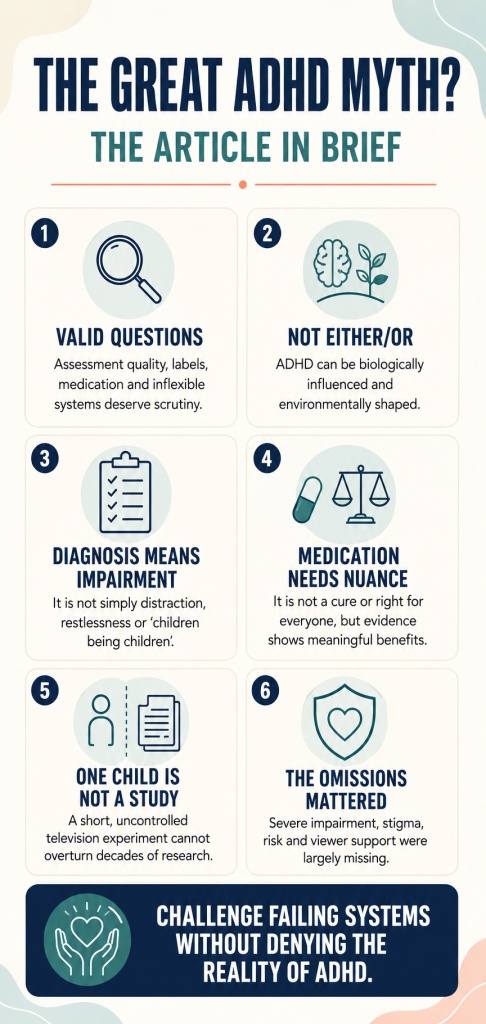
Short on time? Here are the key points
- The programme raised legitimate questions about assessment quality, diagnostic labels, medication, commercial interests, modern lifestyles and inflexible education systems.
- Those questions deserved balanced exploration. Instead, the programme repeatedly presented complex issues as either/or choices and ultimately declared that ADHD is not a neurodevelopmental condition.
- ADHD can be biologically influenced and environmentally shaped. Recognising the role of schools, workplaces, relationships and modern life does not make the underlying difficulties unreal.
- ADHD is not diagnosed simply because someone is distracted, restless or behaves like a child. Diagnosis requires a persistent developmental pattern and significant impairment across important areas of life.
- Medication does not cure ADHD and is not right for everyone. However, research shows that it can reduce core symptoms and may be associated with improvements in serious real-world outcomes. Decisions should be individualised and carefully reviewed.
- One child stopping medication while simultaneously changing his diet, screen use, exercise, outdoor activity and family routines cannot establish what caused any changes or overturn decades of research.
- The programme largely omitted people with severe ADHD-related impairment and provided no support signposting, despite the risk of increasing shame, stigma and distress.
The central message: We should scrutinise assessments, medication, commercial interests and the systems that fail neurodivergent people. We can do that without denying the reality of ADHD or invalidating those whose lives are significantly affected by it.
The Great ADHD Myth?: A psychologist’s perspective on what the programme got right - and what it dangerously missed
By Dr Clare Stone, Chartered Counselling and Coaching Psychologist
As a psychologist, I am trained not to accept claims uncritically simply because they are familiar, popular or expressed by someone in authority. Good psychological science requires curiosity, humility and a willingness to change our minds when the evidence changes.
I therefore did not object to Channel 4’s The Great ADHD Myth? because it asked difficult questions.
There are important questions to ask about the quality of ADHD assessments, the growth of private provision, financial interests in healthcare, the long waits for NHS care, the effects of receiving a diagnostic label, the role of medication and the extent to which schools and workplaces accommodate different minds.
What concerned me was the programme’s polarisation of these questions. Again and again, complex issues were presented as binary choices: biology or environment; neurodevelopmental condition or social construct; medication or lifestyle; helping a child learn or allowing them to be themselves.
The presenter, psychiatrist Dr Max Pemberton, concluded:
“I am now convinced it is a myth that ADHD is a neurodevelopmental disorder. Actually, I think it’s a set of difficult behaviours, a social construct. Not a disorder of the brain.”
This was not expressed tentatively as a personal interpretation or one position within a contested debate. It was delivered with striking certainty, as though the making of one television programme had overturned decades of genetic, developmental, clinical and neuroscientific research.
That use of medical authority is the aspect I found most troubling.
What the programme got right
A balanced response must acknowledge that several questions it raised are legitimate.
Assessment quality needs scrutiny
Not every ADHD assessment is necessarily of equal quality. Long NHS waits have created a market in which private providers vary in their experience, methods, professional composition and follow-up arrangements. Some people pay substantial sums only to discover that their report will not be accepted for prescribing or shared-care purposes. A rushed, questionnaire-led process risks both overdiagnosis and underdiagnosis.
A proper assessment is not simply a matter of recognising a few familiar traits. Many people lose things, procrastinate, become distracted or feel restless. Diagnosis requires a persistent developmental pattern, clinically significant functional impairment and difficulties across relevant settings. It should also consider alternative explanations and co-occurring conditions.
Pemberton paid £1,200 for a private online assessment and received a diagnosis that he rejected because he did not feel disabled or significantly impaired. We cannot judge the full assessment from an edited sequence. If impairment was not established, however, that raises a legitimate question about the quality of that particular assessment.
There is also another possibility worth considering. Intelligent, outwardly successful people can build substantial scaffolding around their difficulties: rigid systems, reminders, overpreparation, reliance on urgency or enormous compensatory effort. This can conceal impairment from others and sometimes from the person themselves.
Those strategies may work for years before increased responsibilities, stress, burnout or hormonal transitions overwhelm them. Many women, for example, describe previously effective coping strategies unravelling around perimenopause, although research into the specific relationship between ADHD and menopause remains emergent.
Diagnosis and labels can affect identity
The programme was also right to invite discussion about what happens psychologically when we give someone, particularly a child, a diagnostic label.
A diagnosis can become a framework for understanding and accessing support. It can relieve years of shame by replacing “lazy,” “badly behaved” or “not trying” with a more accurate account of why some things are difficult. But a label can also be absorbed as a fixed limitation. If communicated poorly, it may contribute to stigma, lowered expectations or learned helplessness.
When my own son was diagnosed, we followed the guidance of his educational psychologist and were careful about how we introduced this. We initially focused less on the diagnostic name and more on helping him understand that his brain worked in a particular way: some things were harder, some strategies could help, and none of this defined his worth or potential.
That is a valid concern for every diagnostic process. But it does not follow that diagnosis inevitably makes people stop trying or that accommodations “excuse” them from developing skills. Appropriate accommodations provide access. They reduce unnecessary barriers so that a person has a fairer opportunity to learn, participate and build skills. Support and personal agency are not opposites.
Medication decisions deserve honesty and compassion
Medication can have side effects. Appetite reduction, sleep disruption and changes in energy or emotional tone should not be dismissed. The teacher’s reflections in the programme were among its most humane moments: medication appeared to help the child engage with formal learning, but people around him also missed some of his playfulness and spontaneity.
That is a real and painful dilemma. Children are not collections of symptoms to be made more convenient for adults.
If someone feels emotionally flattened, “less fun” or unlike themselves, that matters. It may indicate that the dose, timing, formulation or medication should be reviewed. It may contribute to a decision not to medicate. Equally, some children report feeling calmer, more emotionally regulated and more able to sustain friendships while appropriately medicated.
The task is not to impose one answer on every family. It is to weigh benefits and costs for the individual, include the child’s experience, titrate carefully and review the decision over time.
Environment and modern life matter
Sleep, physical activity, nutrition, stress, routines, family support, time outdoors and patterns of screen use can all affect attention, mood and self-regulation. Modern life frequently fragments attention, while many children have less freedom to move, play outdoors and learn through varied activities.
There is evidence that exercise can improve inattention, inhibitory control and cognitive flexibility in children and young people with ADHD. Nature exposure can support attention and mood, although the evidence is more limited and does not establish it as a stand-alone treatment. These approaches are valuable because they can improve wellbeing and functioning, not because they disprove ADHD.
As both a psychologist and a parent, I am aware of the importance of limiting excessive gaming and screens, encouraging outdoor activity, supporting sleep, offering a healthy diet and trying approaches such as yoga. We have done these things with my son. They help, but they have not made his ADHD disappear.
I want to be clear. Families should not be left believing that continuing difficulties mean they have failed to provide the correct food, boundaries, exercise or parenting.
The system does need to change
On this, I agree wholeheartedly with the programme. Schools, workplaces and healthcare systems often fail to accommodate human variation. Support should not depend entirely on a diagnostic label, and medication should never substitute for adequate educational support, reasonable adjustments or psychologically informed care.
Many schools are structured around prolonged sitting, sustained attention, conformity and a narrow range of ways to learn or demonstrate ability. That will disadvantage many learners, with or without ADHD. We should create education systems with more movement, creativity, written and verbal instruction, manageable task lengths and different routes to participation.
But changing the education system and recognising a child’s neurodevelopmental needs are not mutually exclusive. The school environment can be problematic without the child’s difficulties being imaginary.
Where the programme became misleading
“Social construct” was used as though it meant “not real”
There is a limited sense in which ADHD, like diagnostic categories across medicine and mental healthcare, is socially constructed. Humans create the name, define the criteria and decide where a continuous distribution of traits becomes sufficiently impairing to justify diagnosis and intervention.
There is no line drawn by nature labelled “ADHD starts here.” The threshold is a clinical and social decision informed by research, values and the consequences of acting or not acting. Similar judgement is involved when medicine sets thresholds for hypertension, or when psychiatry determines when low mood becomes a depressive disorder.
But the fact that a category and its boundary are constructed does not mean that the underlying traits, distress, impairment, developmental patterns, genetic influences or group-level biological findings were invented by a committee.
The programme repeatedly collapsed those two propositions. It treated “neurodevelopmental” and “social” as mutually exclusive, when contemporary psychology understands people through interactions between biology, development, relationships, culture and environment.
Something can be biologically influenced and environmentally shaped. Its visibility and disabling impact can change with context without the underlying vulnerability being imaginary.
The World Health Organization classifies ADHD as a neurodevelopmental disorder in ICD-11. NICE, the NHS and the DSM-5-TR recognise it. The 2021 World Federation of ADHD International Consensus Statement drew together 208 empirically supported conclusions from large studies and meta-analyses, endorsed by 80 authors across 27 countries. Scientific consensus is not sacred, but overturning it requires evidence of comparable strength, not selective interviews, assertion and a single televised case.
A rise in referrals is not proof of a new epidemic
The programme emphasised how rare ADHD diagnoses once appeared and how sharply referrals and diagnoses have risen. Social media, greater public discussion and changing expectations have undoubtedly influenced help-seeking. Poor-quality information can encourage people to overidentify with ordinary traits, and systems that make support dependent on diagnosis can create additional incentives to seek one.
However, rising recognition and service demand are not the same as rising underlying prevalence.
The Government’s 2026 independent interim review reported that the number of children and young people waiting for an ADHD assessment in England rose from around 21,000 in April 2019 to around 270,000 by December 2025. Yet the best available population surveys suggest that the underlying prevalence of ADHD symptoms has been much more stable, with no evidence of a dramatic population-level increase over recent decades.
The review’s conclusion is more complex: relatively stable underlying prevalence can coexist with rapidly rising referrals, diagnoses and demand. Increased awareness, reduced stigma and improved recognition of groups historically missed; including girls, women and some minority group, can bring previously hidden need into view.
Some overdiagnosis, some misdiagnosis and substantial underdiagnosis can all exist simultaneously. This is precisely the kind of both/and thinking the documentary lacked.
Diagnostic manuals are imperfect tools, not inventions without evidence
Diagnostic systems deserve critical scrutiny. Categories change, thresholds involve judgement, and historical versions have contained serious cultural biases. They should never be treated as infallible maps of human experience.
However, portraying the DSM or ICD as though a few psychiatrists casually invented diagnoses around a table is misleading. These classification systems are not simply invented by a small group of psychiatrists. Their development and major revisions involve reviews of scientific evidence, multidisciplinary expert groups, professional and public consultation, and field testing. Proposed diagnostic criteria are scrutinised in relation to their validity, reliability, feasibility and clinical usefulness.
They are human-made and imperfect, but they are not simply “made up.”
“Diagnosing children for being children” misunderstands impairment
ADHD traits are continuously distributed. Everyone experiences distraction, impulsive moments or restlessness. That is not evidence against ADHD, any more than everyone experiencing sadness makes severe depression unreal.
Diagnosis is not based on the mere presence of recognisable behaviours. It asks whether they are developmentally atypical in their persistence or intensity, evident across settings, traceable to childhood and associated with significant functional impairment. The NHS explicitly notes that many children are distracted, impulsive and energetic and that this alone does not mean they have ADHD.
Presenting ADHD as “children being children” also risks reviving the idea that difficulties arise from permissive parenting or poor discipline. That is both inaccurate and stigmatising.
The presenter’s diagnosis raised questions but did not answer the programme’s thesis
Pemberton’s own ADHD assessment is interesting precisely because several explanations remain possible. The assessment may have been insufficiently rigorous. Functional impairment may have been underexplored or poorly communicated. Alternatively, he may have developed effective scaffolding that obscures difficulties. We cannot determine which from the broadcast.
Nor is it enough to assume that a highly intelligent and professionally successful person could only have mild ADHD. Success does not measure the effort, exhaustion or hidden cost required to maintain it.
The programme appeared to use his diagnosis to suggest that anyone who wants one can obtain one. That sweeping implication was unfair to people who approach assessment reluctantly after years of difficulty, often carrying considerable stigma and self-doubt.
His experience supports an argument for high-quality assessment and regulation. It does not demonstrate that the diagnosis itself is a myth.
The brain-imaging argument confused two different questions
It is true that ADHD cannot currently be diagnosed from an individual MRI scan. Professor Katya Rubia said this in the programme.
What does not follow is that ADHD therefore has no biological or neurodevelopmental basis.
Research can identify average differences between groups without those findings being consistent or precise enough to classify an individual. ADHD is heterogeneous: people meet criteria through different combinations of traits and have different developmental histories, compensatory strategies and co-occurring conditions.
The international ENIGMA mega-analysis of more than 3,200 participants found small group-level differences in several subcortical brain volumes, particularly in children. Large genetic studies have identified multiple regions of DNA associated with ADHD, including links to genes that are particularly active during early brain development. These findings do not provide a diagnostic scan or prove there is one uniform “ADHD brain.” They do contradict the claim that the absence of an individual biomarker proves an absence of biology.
Interestingly, after the broadcast, Professor Katya Rubia subsequently stated that her contribution had been “largely misrepresented”, with comments cherry-picked, truncated and presented out of context.
She clarified that although current brain scans cannot diagnose ADHD in an individual, this does not mean that ADHD has no neurobiological correlates. Three decades of neuroimaging research have identified average group-level differences in brain structure, function and connectivity. She also acknowledged that these differences are generally small and that ADHD is highly heterogeneous, meaning that not every person shows the same neurobiological pattern.
Both facts can be true: current scans cannot diagnose an individual, and credible group-level neurobiological evidence exists.
Neuroplasticity does not mean ADHD can simply be trained away
The brain is plastic. Learning, relationships, stress, practice, medication and environment can change neural pathways and behaviour. This is one reason psychological strategies, coaching, habit-building and adjustments can improve functioning.
But “the brain can change” does not mean that every inherited or developmental vulnerability can be erased through enough effort. Neuroplasticity is a capacity, not a promised cure.
Longitudinal studies following children with ADHD through adolescence and into young adulthood show that symptom severity and presentation can change, and often fluctuate, over time.
This does not mean that ADHD simply disappears: in one major 16-year study, sustained remission was uncommon, and many participants experienced a recurrence after a period of improvement.
Environment and learned strategies can alter how ADHD is expressed and how disabling it becomes. That is not evidence that lifestyle-driven neuroplasticity reliably removes it.
One child’s experience cannot overturn a research field
Mason’s story was emotionally engaging, but it was not a scientific experiment capable of answering whether ADHD exists.
Medication, screens, diet, supplements, exercise, nature exposure, structured activities and family attention all changed together. There was one child, no control group, no blinding and a short follow-up, all within the unusual context of being filmed for television. No causal conclusion can be drawn from that design.
The programme foregrounded the positive changes: Mason seemed happier, more playful and more socially engaged. Yet his teacher later described greater disruption, fidgeting and difficulty completing work. The brief end text revealed that he returned to medication and that his schoolwork improved. Viewers who looked away or switched off early could easily have missed the result that most complicated the programme’s narrative.
This does not prove every child should take medication. It shows that the attempted experiment did not support the sweeping conclusion drawn from it.
I also found myself wondering how Mason’s mother felt watching a programme in which she had participated ultimately declare that her child’s ADHD was a myth. I cannot know her view, but it highlights the ethical tension in using one child’s life as the narrative vehicle for a predetermined conclusion.
Medication does not need to “cure” ADHD to provide treatment
Pemberton argued that medication does not cure anything; it suppresses or controls symptoms. But many accepted medical treatments manage a condition rather than eliminate its cause. Asthma inhalers, antihypertensive medication and many treatments for chronic pain or mental-health conditions work while they are taken. That does not make them fraudulent or dystopian.
The relevant question is not whether medication permanently cures ADHD. It is whether it safely improves symptoms, functioning, autonomy, wellbeing and longer-term outcomes enough to justify its risks for that individual.
Randomised trials show that ADHD medication reduces core symptoms. Large observational studies associate treatment with lower rates of suicidal behaviour, substance misuse, transport accidents and criminality. A 2024 study found that medication initiation was associated with lower all-cause and unnatural-cause mortality during the following two years. Observational evidence cannot prove every benefit is caused by medication, but it directly challenges the claim that medication merely optimises compliant behaviour.
Medication is not right for everyone. NICE recommends implementing and reviewing environmental modifications first, then offering medication to children aged five and over, young people and adults when significant impairment persists. Treatment should be individualised rather than governed by ideology in either direction.
What the programme missed
The people most severely affected
Where were the adults unable to sustain employment despite enormous effort? Those overwhelmed by daily administration, unsafe impulsivity, debt or relationship breakdown? The people living with secondary anxiety, depression, addiction or profound shame? Those whose outward success depends on exhausting compensation and eventually ends in burnout?
Unsupported ADHD is associated with higher risks of educational failure, accidents, substance misuse, criminal-justice involvement, mental-health difficulties and premature mortality. This does not mean every person with ADHD experiences disability in the same way, but it makes dismissive framing consequential.
A programme asking whether ADHD is real should include the experiences most capable of challenging its preferred conclusion, including adults and people at the severe end of the spectrum.
The possibility of difference, disability and contextual strength coexisting
Some people understand their ADHD primarily through neurodiversity rather than disorder. Some experience contextual strengths and do not identify as disabled. This is where some ADHD-related traits can be helpful in the right circumstances. For example, intense focus, creativity, spontaneity or rapid thinking may be valuable in certain roles or environments, while those same traits may create difficulties in others. Others experience ADHD as profoundly disabling. Neither should be required to speak for everyone.
The right question is not simply “difference or disorder?” It is: what is this person experiencing, how is it affecting their life, what strengths and needs are present, and what combination of environmental, psychological, educational and medical support would improve their autonomy and wellbeing?
The potential harm - and the absence of support
The Royal College of Psychiatrists warned after the programme that invalidating a neurodevelopmental condition can fuel stigma and discourage people from seeking support and treatment.
For someone already wondering whether they are lazy, weak, badly behaved or making excuses, hearing a psychiatrist declare with certainty that ADHD is a myth can deepen shame. Parents may feel blamed. Employers and teachers may feel licensed to withdraw understanding. People may stop medication or abandon an assessment without seeking appropriate advice.
Having rewatched the programme and watched the end credits carefully, I could find no signposting to support for viewers who felt distressed or triggered. Given the well-established association between ADHD and increased rates of depression, self-harm and suicide, failing to provide even basic support signposting was not a minor oversight. In my view, it was a grave and inexcusable failure of responsibility towards the very people the programme knew, or should have known, could be deeply distressed by its content.
Conclusion: challenge the system, not the existence of the people it is failing
The programme was right that our systems need to change. It was right to question assessment quality, commercial incentives, overreliance on medication and educational environments that demand a narrow range of behaviour. It was right to show that medication decisions can involve real loss as well as benefit. It was right to ask what diagnostic labels do to identity.
But none of those points demonstrates that ADHD is a myth.
We can recognise that diagnostic categories have socially constructed boundaries while accepting that the phenomena they describe are real. We can value neurodiversity while acknowledging disability. We can improve nature access, exercise, diet, sleep, schooling and screen habits without pretending they reliably remove a highly heritable developmental condition.
We can scrutinise private clinics and pharmaceutical companies without treating every clinician as corrupt or every patient as a consumer purchasing an excuse. We can offer accommodations while still building skills and agency. We can use medication carefully without portraying it as either a miracle or punishment.
What I hoped to see was a genuinely critical programme: one that put controversial claims beside the strongest evidence against them, included researchers with substantial ADHD expertise, represented people across levels of impairment and allowed viewers to reach informed conclusions.
Instead, I saw a highly polarised, one-sided argument presented with the authority and appearance of a scientific investigation.
I believe it is legitimate to ask Channel 4 and the relevant professional regulator to consider whether appropriate evidential, editorial and professional standards were met. That is not to presume misconduct. It is to ask who is accountable when authoritative health communication may foreseeably cause harm.
The response since the broadcast has offered some hope. Psychologists, psychiatrists, neuroscientists, researchers, charities, advocates and people with lived experience have challenged omissions and stood beside those who felt invalidated. Professor Rubia has clarified that her contribution was taken out of context. ADHD UK has complained to Ofcom. The Science Media Centre has collated detailed responses from specialists in ADHD research and clinical practice.
That collective response matters. It tells people with ADHD, those awaiting assessment and those still trying to understand themselves:
You are seen. Your experiences are real. You are not standing alone.
Sources and further reading
- Science Media Centre: expert reaction to The Great ADHD Myth?
- ADHD UK: Challenging Channel 4’s The Great ADHD Myth?
- Channel 4 press release for The Great ADHD Myth?
- UK Government (2026): Independent review into mental health conditions, ADHD and autism — interim report
- NICE guideline NG87: ADHD diagnosis and management
- NHS: ADHD in children and young people
- Faraone et al. (2021): World Federation of ADHD International Consensus Statement
- Hoogman et al. (2017): ENIGMA mega-analysis of brain volumes
- Demontis et al. (2023): Genome-wide analyses identifying 27 ADHD risk loci
- Sibley et al. (2022): Variable patterns of remission from ADHD
- Vysniauske et al. (2023): Exercise interventions for children and adolescents with ADHD
- Dalsgaard et al. (2015): Mortality in people with ADHD
- Li et al. (2024): ADHD pharmacotherapy and mortality
- Zhang et al. (2025): ADHD treatment and real-world risks
This article offers general psychological information and commentary. Anyone considering changing or stopping ADHD medication should first speak with their prescriber.

The Great ADHD Myth? The Real Myth Is That This Is Responsible Journalism
Channel 4’s controversial new ADHD documentary, The Great ADHD Myth?, will air on Tuesday 18 August at 8pm.
I have not seen the documentary yet.
It may contain thoughtful contributions. It may raise legitimate questions about ADHD diagnosis, medication and the effects of modern life on our attention. These are important conversations.
However, my concern is not currently with the contents of the documentary.
It is with the way Channel 4 has chosen to market it.
And I believe Channel 4 should be ashamed.
Is ADHD “genuine”?
Channel 4 announced The Great ADHD Myth? with a press release stating that the programme would seek to determine “whether ADHD is a genuine neurodevelopmental disorder, or a social construct.”
It opened by asking whether children should be given “powerful psychiatric drugs” to medicate it.
These words were not taken out of context by an angry social-media user. They were deliberately chosen by Channel 4 to generate interest in its own programme.
Words matter.
When you place the word “myth” beside an already highly stigmatised condition and ask whether it is “genuine,” you are not simply opening a neutral scientific discussion.
You are planting doubt.
You are handing ready-made language to people who already believe that ADHD is an excuse, a fashionable label, poor parenting or a lack of discipline.
Channel 4 understands how headlines work. It understands that provocative language generates reactions, arguments, shares and viewers.
But people with ADHD should not become collateral damage in a marketing campaign.
Debate is not the problem
There are important questions to explore about ADHD.
Why are more people seeking assessment? Why have so many women and adults previously been overlooked? Are all assessments completed to an appropriate standard? How do sleep, stress, trauma, technology, education and working conditions affect our attention? When is medication appropriate, and how should it be monitored?
Our environment unquestionably influences our ability to concentrate.
Johann Hari’s Stolen Focus, for example, explores research and arguments about the societal forces competing for our attention. Phones, algorithms, chronic stress, disrupted sleep and constant interruption can all make concentration more difficult.
For somebody with ADHD, these conditions may intensify difficulties that are already present.
Recognising environmental influences does not require us to deny biological or developmental differences. Biology and environment are not competing explanations. Human beings are always shaped by interactions between our genetics, development, relationships, experiences and surroundings.
Presenting ADHD as either a “genuine” neurodevelopmental condition or a social construct therefore creates a false and unnecessarily inflammatory choice.
ADHD is not a myth
ADHD is recognised within established international diagnostic systems. In the UK, NICE has an evidence-based guideline covering its recognition, assessment and management in children, young people and adults.
The scientific evidence does not suggest that ADHD was suddenly invented by smartphones or social media.
The World Federation of ADHD International Consensus Statement brought together 208 evidence-based conclusions approved by 80 authors from 27 countries. The research reviewed supports the substantial heritability of ADHD, its presence across different countries and cultures, and the involvement of both genetic and environmental factors.
Research has also identified modest average differences in aspects of brain development, structure and function between groups of people with and without ADHD.
That does not mean ADHD can be diagnosed using a brain scan. It cannot. These are group-level findings rather than a test that can determine whether one individual has ADHD.
They do, however, form part of a much broader body of evidence that cannot reasonably be reduced to people being distracted by their phones or seeking an excuse for their difficulties.
Science should always remain open to scrutiny. Diagnostic practices, prescribing decisions and the quality of services should be examined carefully.
But scrutinising how ADHD is diagnosed and treated is very different from asking whether ADHD itself is genuine.
ADHD UK challenged Channel 4
On 4 August, the charity ADHD UK sent an open letter to Channel 4 raising concerns about the title, promotional framing, scientific balance and potential impact on people with ADHD.
The letter did not ask Channel 4 to avoid difficult questions. It explicitly acknowledged that waiting lists, service failures, diagnosis and treatment deserve serious investigation.
Its objection was to presenting an established neurodevelopmental condition as a possible myth in order to launch that discussion.
Channel 4 replied on 10 August. It said its remit includes stimulating public debate and challenging conventional understandings. It confirmed that the title was posed as a question intentionally because the programme seeks to “encourage debate.”
This response was deeply disappointing.
It treats the objection as though people with ADHD and those advocating for them simply do not want debate. That entirely misses the point.
Debate can be healthy. The problem is the way Channel 4 has chosen to manufacture that debate.
Adding a question mark does not remove the impact of the word “myth.” Nor does saying that the title is not a definitive statement undo the doubt it creates.
To be fair, Channel 4 did respond to some specific points. It identified the professionals involved in overseeing a child’s break from ADHD medication during filming, and it cited newer NHS data to defend one of its prescribing statistics.
Those answers should be acknowledged.
What its response did not meaningfully acknowledge was the central concern: the foreseeable effect of inviting millions of people to question whether ADHD is genuine.
There was no apology for the promotional framing, no indication that the title would be reconsidered and no recognition that harm can occur before the documentary has even aired. ADHD UK also reports that it was offered no preview or right of reply, and received no commitment that support would be signposted during the programme.
That is not an adequate response to the concerns being raised.
ADHD stigma has real consequences
In my work as a psychologist, I regularly encounter the effects of ADHD stigma.
I work with people who have spent years being described as lazy, careless, unreliable, undisciplined or simply not trying hard enough.
Some have experienced discriminatory or deeply insensitive treatment in the workplace. Others face disbelief within their families and relationships.
Comments such as “everyone is a bit ADHD these days” or “it’s just an excuse” remain remarkably common.
These attitudes affect whether people seek an assessment, disclose a diagnosis or ask for reasonable support. They influence whether children grow up understanding their difficulties or believing there is something fundamentally wrong with their character.
Receiving an ADHD diagnosis does not absolve somebody of responsibility for their behaviour. It can, however, give them a framework for understanding themselves, accessing appropriate support and developing strategies that work for their brain.
Questioning whether their condition is genuine reinforces the very shame and misunderstanding many have spent years trying to overcome.
Matt Haig is right to challenge the title
Author Matt Haig, who has spoken openly about his ADHD diagnosis, was among those who challenged Channel 4’s announcement.
He wrote that the title “causes real damage” and referred to evidence from family, twin and neuroimaging research. He also described the clarity that receiving an ADHD diagnosis gave him after being labelled as having special needs at school without being told why.
His response brings the human consequences back into view.
This is not simply an intellectual debate among broadcasters, clinicians and commentators. It concerns real people who often lived with these difficulties for decades before finally having language to understand them.
Ethical communication matters
As a psychologist, I think carefully about how I communicate psychological ideas.
I could probably attract more attention by using frightening headlines, oversimplifying research or deliberately provoking outrage. Emotionally charged and threatening information captures attention quickly.
But attracting attention is not the only consideration.
I have a professional and ethical responsibility to consider the effect of what I put into the world. I want my work to increase understanding, reduce shame and help people make sense of their experiences—not exploit vulnerability or controversy to generate clicks.
A major public-service broadcaster should apply the same principle.
Channel 4 could have promoted a rigorous investigation into rising ADHD referrals, assessment standards, medication and the effects of modern environments.
It could have encouraged curiosity without questioning whether ADHD itself is genuine.
Instead, it chose The Great ADHD Myth?
People with ADHD deserve better
I will reserve judgement on the documentary itself until it has been broadcast. I sincerely hope its contents are more balanced and scientifically responsible than its marketing suggests.
But the effect of its promotional framing is already being felt.
People with ADHD are once again being asked to defend the legitimacy of their condition. Advocates and professionals are having to correct misconceptions before the programme has even aired. Meanwhile, those who already dismiss ADHD have been given a national headline that appears to validate their prejudice.
There is room for debate about diagnosis, treatment, environmental influences and the way society responds to human differences.
There should not be a need to debate whether an established neurodevelopmental condition is “genuine” simply to sell a television programme.
People with ADHD deserve thoughtful journalism. They deserve evidence rather than insinuation, curiosity rather than clickbait, and public conversations that increase understanding instead of deepening stigma.
They deserve better than this.

ADHD Burnout at Work: Why High Achievers Get Stuck in a Cycle of Exhaustion
ADHD burnout is increasingly recognised as a common experience for many adults with ADHD, particularly high-achieving professionals.
Unlike general workplace burnout, ADHD burnout is often linked to years of masking difficulties, compensating for executive functioning challenges, and relying on urgency to maintain performance.
Recently, I was reading an article by consultant psychiatrist Dr Stefan Ivantu about ADHD and career burnout. One idea stood out to me because it mirrors something I’ve seen repeatedly in both my professional work and personal experiences around ADHD.
Many people assume burnout happens because someone takes on too much.
But for many adults with ADHD, the process often starts much earlier.
It starts with compensation.
The Hidden Cost of Coping
Many adults with ADHD become incredibly skilled at finding ways around their difficulties.
They work longer hours.
Double-check everything.
Over-prepare.
Create endless systems.
Use anxiety, pressure or deadlines to get things done.
From the outside, they often appear successful, capable and dependable.
Yet maintaining that level of performance can require an enormous amount of energy.
This is particularly true for professionals, business owners, healthcare workers, teachers, parents and anyone who feels a strong responsibility to perform well.
The problem isn’t a lack of effort.
It’s that effort that becomes the solution to everything.
The ADHD Burnout Cycle
The infographic below illustrates a pattern that many adults with ADHD will recognise.
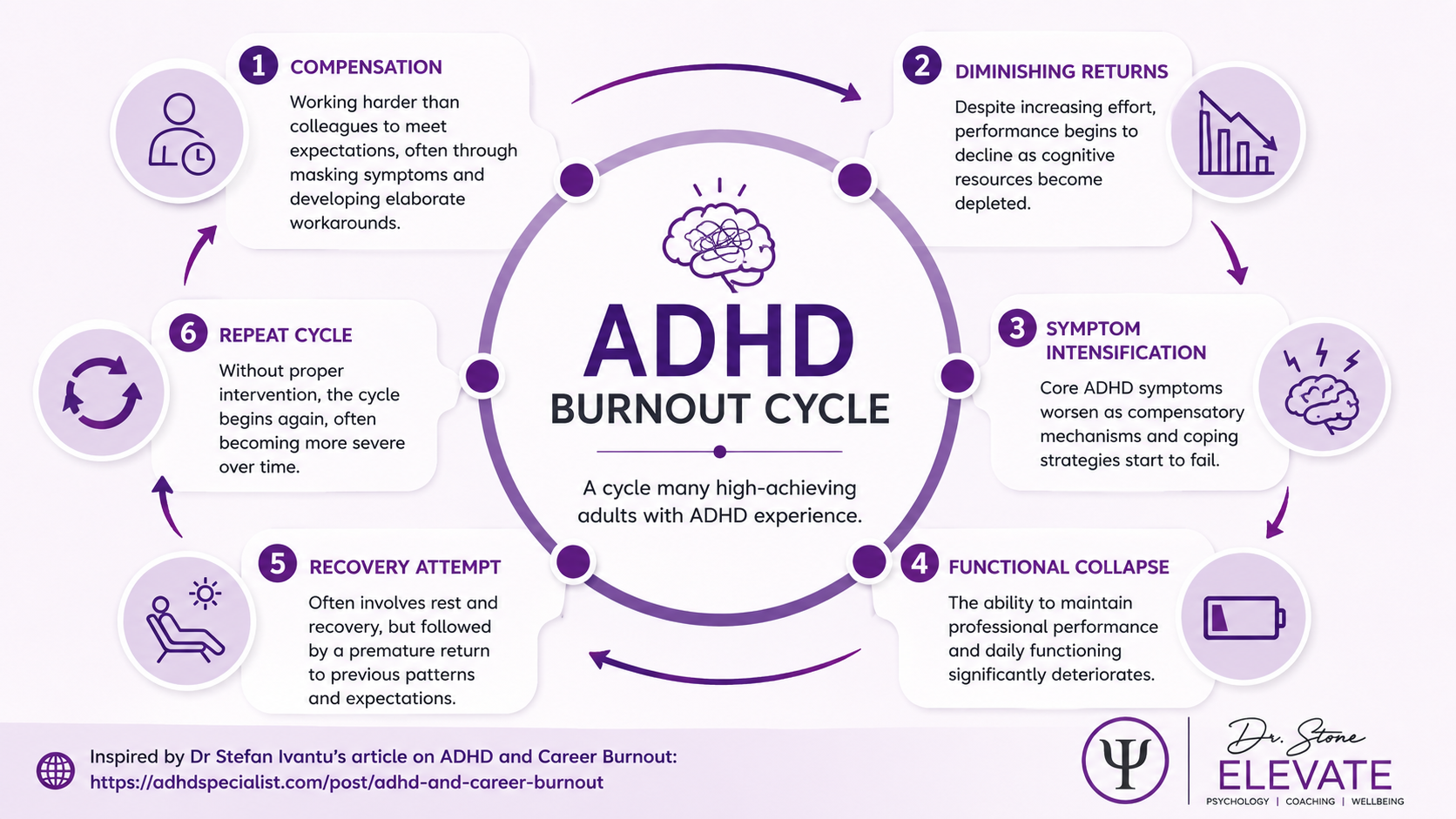
What strikes me about this cycle is that ADHD burnout doesn’t begin with exhaustion.
It begins with working harder.
Many people spend years compensating for difficulties that others never see.
Eventually, however, those strategies become harder to sustain.
Mental resources become depleted.
Concentration becomes more difficult.
Organisation starts to slip.
Emotional regulation takes more effort.
Many people assume they are becoming lazy, less capable or less motivated.
In reality, they may simply be experiencing the effects of ADHD burnout.
Common Signs of ADHD Burnout
Although everyone’s experience is different, common signs of ADHD burnout can include:
- Persistent exhaustion, even after resting
- Increased forgetfulness
- Difficulty concentrating
- Feeling overwhelmed by everyday tasks
- Increased procrastination
- Emotional sensitivity or irritability
- Loss of motivation
- Feeling unable to keep up with responsibilities that previously felt manageable
Many of these symptoms can be mistaken for laziness, lack of discipline or personal failure.
In reality, they may be signs that your brain and nervous system have been working overtime for too long.
Why Rest Alone Doesn’t Solve ADHD Burnout
When people reach breaking point, they often know they need rest.
Perhaps they take annual leave.
Reduce their workload.
Or take some time away from responsibilities.
And often they feel better.
The difficulty is that recovery doesn’t automatically change the pattern.
Many people return to the same expectations, the same overcommitment, the same perfectionism and the same habit of pushing through warning signs.
Before long, they find themselves back in the same cycle.
This is one reason why ADHD burnout can feel so confusing.
You recover, but somehow end up back where you started.
Breaking the Cycle
In my experience, recovering from ADHD burnout isn’t simply about becoming more productive.
It’s about becoming more aware.
Recognising early warning signs.
Understanding how your brain works.
Learning that rest isn’t something that needs to be earned.
And creating ways of working that don’t rely entirely on pressure, urgency and adrenaline.
Because if your success depends on constantly compensating, masking and pushing beyond your limits, burnout isn’t necessarily a sign that you’ve failed.
It may simply be a sign that the strategy itself is no longer sustainable.
A Question to Reflect On
As you look at the cycle above, which stage do you recognise yourself in right now?
The answer might tell you more about your wellbeing than any productivity app ever could.
Feeling overwhelmed?
If this article resonated with you, my free 5-Step Overwhelm Reset will help you slow racing thoughts, regain clarity and take your first steps towards feeling more in control.
Download your free guide here → http://welcome.drstoneelevate.com/gift
This article was inspired by insights from consultant psychiatrist Dr Stefan Ivantu’s work on ADHD and career burnout. You can read the original article here: https://adhdspecialist.com/post/adhd-and-career-burnout
ADHD: Is It Time We Rethink the Name?
What if one of the most common things people believe about ADHD isn't actually true?
The more I've learned about ADHD as a psychologist, as a parent, and through my own personal experiences, the more I've found myself questioning the name itself.
Attention Deficit Hyperactivity Disorder.
It's a label most of us recognise, but I'm not convinced it accurately reflects what many people with ADHD actually experience.
As a psychologist, I spend a lot of time supporting people who are struggling with overwhelm, burnout, confidence, self-criticism and life transitions. Increasingly, many of those conversations involve ADHD.
This is also a topic that feels personal to me.
I identify with many ADHD traits, although I do not currently have a formal diagnosis. My son has ADHD (predominantly inattentive presentation), and my partner has ADHD combined presentation. Alongside my professional training, I've spent years learning about ADHD through lived experience, supporting loved ones, undertaking specialist training, and working with many neurodivergent individuals throughout my career.
Many adults discover ADHD later in life after years of struggling with concentration, overwhelm, procrastination, burnout, emotional regulation difficulties, or simply feeling different from those around them. For some, receiving a diagnosis brings a profound sense of relief and understanding. For others, it raises new questions about identity, strengths and challenges.
One of the questions I keep coming back to is whether the name itself tells the full story.
Is ADHD Really an Attention Deficit?
When most people hear the term "attention deficit", they assume it means a lack of attention.
But that isn't what many people with ADHD describe.
In fact, many people with ADHD can focus exceptionally well.
Sometimes incredibly well.
They can become completely absorbed in topics that interest them. Hours can disappear. Creativity can flow. Complex problems can be solved. They may notice details that others miss and demonstrate extraordinary persistence when engaged in something meaningful.
The challenge isn't necessarily having too little attention.
The challenge is often having difficulty regulating attention.
Some tasks seem almost impossible to engage with, regardless of how important they are. Other activities capture attention so completely that switching away becomes difficult.
It's less about a deficit and more about inconsistency.
Many people with ADHD find that their attention is drawn more strongly by interest, novelty, urgency or emotional significance than by importance alone.
That's a very different thing.
The ADHD Adults Nobody Notices
When many people think about ADHD, they still picture the stereotypical child who can't sit still in class.
But that's often not the reality.
Many adults with ADHD don't fit the stereotype people expect.
They may be professionals, healthcare workers, teachers, business owners, managers, parents or students.
They can be highly intelligent, capable and successful.
They often appear organised and competent from the outside.
Yet behind the scenes, they may be working twice as hard as everyone else just to stay on top of things.
They may spend enormous amounts of energy masking difficulties, compensating for forgetfulness, over-preparing, managing overwhelm, or trying to avoid letting people down.
By the time they seek support, many are exhausted.
Not because they're incapable.
But because they've spent years trying to meet expectations in ways that don't come naturally to them.
The Part I Struggled With Most
When my son was diagnosed, I remember feeling enormous relief.
For years, I had been noticing things that others weren't seeing.
His difficulties weren't always obvious at school. He was bright, generally well behaved, and achieving within expected ranges. Much of the struggle happened at home.
The diagnosis brought validation.
But it also brought something I found surprisingly difficult.
The word "disorder".
As a parent, it's hard to hear your child described in deficit-based terms.
No parent wants their child to believe they are 'broken'.
No parent wants them to believe there is something fundamentally wrong with who they are.
Of course, diagnoses have an important purpose. They help people access support, accommodations, understanding and, where appropriate, treatment.
For many people, receiving an ADHD diagnosis is life-changing and deeply validating.
But I still wonder whether the language we use fully captures the whole picture.
What If ADHD Is Also a Difference?
ADHD can absolutely be disabling.
Many people experience significant challenges with organisation, planning, emotional regulation, impulsivity, memory, relationships, education, employment and mental health.
Those difficulties are real.
They deserve to be recognised.
But from a neurodiversity perspective, many people would argue that ADHD is not simply a collection of deficits.
It is a different way of processing information, responding to the environment and experiencing the world.
Alongside the challenges, many people with ADHD demonstrate remarkable creativity, innovation, curiosity, intuition, energy, problem-solving ability and out-of-the-box thinking.
The question becomes:
How much of the struggle comes from the individual?
And how much comes from living in environments that were designed with a different type of brain in mind?
Perhaps the Problem Isn't Always the Person
Modern life places enormous demands on executive functioning.
Sustained attention.
Administrative tasks.
Organisation.
Planning.
Time management.
Prioritisation.
Working quietly for long periods.
Managing endless notifications and competing demands.
These are exactly the areas many people with ADHD find most challenging.
Yet these expectations are often treated as the default standard for everyone.
When someone struggles, the assumption is often that they need to try harder.
Be more disciplined.
Get organised.
Use a better planner.
Apply more effort.
But what if the issue isn't effort?
What if the issue is fit?
What if some of the distress comes from spending years trying to force yourself to function in ways that don't align with how your brain naturally works?
A More Helpful Conversation
I'm not suggesting we abandon diagnosis.
Nor am I suggesting we ignore the very real difficulties ADHD can create.
What I am suggesting is that perhaps we need a broader conversation.
One that recognises both the challenges and the strengths.
One that acknowledges disability without reducing people to deficits.
One that moves beyond asking, "What's wrong with you?" and instead asks:
"What do you need in order to thrive?"
For many people, that shift in perspective can be transformative.
Because understanding your brain isn't about discovering what's broken.
It's about discovering how you're wired—and learning how to work with it rather than against it.
If you've recognised yourself in parts of this article, you're not alone.
Whether you're newly diagnosed, questioning whether ADHD may be relevant to you, or simply trying to understand yourself better, self-understanding is often the first step towards meaningful change.
I regularly write about ADHD, burnout, perfectionism, confidence and psychological wellbeing. If these topics resonate with you, you can follow my work on LinkedIn or subscribe to my newsletter for future articles, insights and resources.
Feeling overwhelmed?
If this article resonated with you, my free 5-Step Overwhelm Reset will help you slow racing thoughts, regain clarity and take your first steps towards feeling more in control.
Download your free guide here → http://welcome.drstoneelevate.com/gift